Innovating Capital Access with Alan Kadish
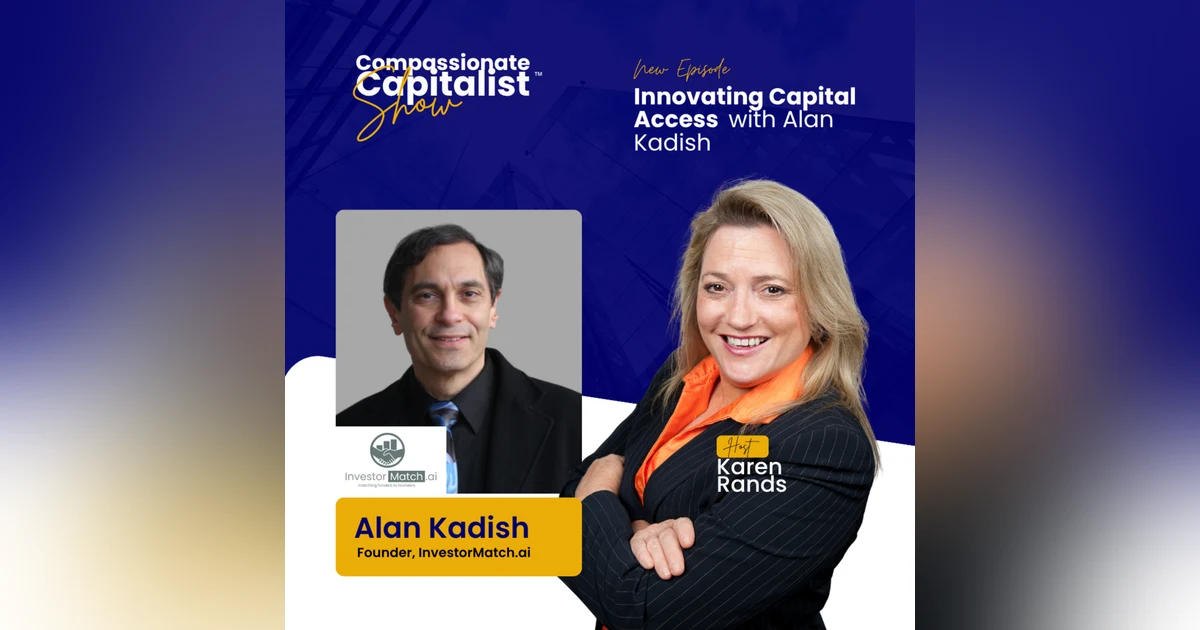


As I talk with entrepreneurs and investors, I often see how easily people overlook the power of strong investor relationships. It’s not just about getting funding, it’s about building trust that lasts.
In this episode, I sit down with Alan Kadish to talk about how founders can build resilience through honest, consistent communication with investors. Alan shares what investors really look for, how transparency earns confidence, and why the best partnerships go beyond money.
If you’re raising capital or managing investor expectations, this conversation will help you see how strong relationships can carry your business through tough times.
Takeaways
Alan Kadesh has a diverse background in innovation and entrepreneurship.
Timing is crucial for entrepreneurial success.
InvestorMatch.ai aims to improve the capital raising process.
The platform is free for founders, funded by investors.
Understanding cap tables is essential for startups.
Navigating regulatory challenges in biomed tech requires expertise.
ExpertScale.ai allows for the encapsulation of knowledge.
Investors are increasingly sophisticated in their decision-making.
AI is transforming the way entrepreneurs connect with investors.
The importance of due diligence in the investment process.
Chapters
00:00 Introduction to Alan Kadesh and His Innovations
02:34 From Surfboards to Bioparticles: Alan's Journey
06:10 The Importance of Timing in Entrepreneurship
08:52 Introducing InvestorMatch.ai: A New Era in Capital Raising
16:52 Streamlining Connections: The Efficiency of InvestorMatch.ai
20:54 Understanding Cap Tables and Financial Forecasting
28:38 Navigating Regulatory Challenges in Biomed Tech
33:14 ExpertScale.ai: Capturing Knowledge for Future Generations
About Alan Kadish
Dr. Alan Kadish is an innovator, entrepreneur, and active angel investor with decades of experience building and funding breakthrough technologies. He’s the founder of InvestorMatch.ai, which uses AI to connect founders with the right capital partners, and ExpertScale.ai, which creates intelligent digital avatars that mirror your expertise to boost productivity.
With a background spanning biomedical research, bioengineering, and venture capital, Alan brings a unique blend of science, strategy, and mentorship to every venture.
Learn more at InvestorMatch.ai and ExpertScale.ai.
About Karen Rands
I'm Karen Rands, founder of the Compassionate Capitalist Movement. I help entrepreneurs prepare to raise capital the smart way and guide investors in identifying startup opportunities that build wealth and make a difference. This show is your roadmap to funding success, from pitch deck to public offering.
📅 Want expert feedback on your pitch? Book a consult with me: bit.ly/KCHcalendar 🔗 Learn more: karenrands.co 🎧 Catch more episodes: thecompassionatecapitalistshow.com 📘 Free eBook: The 4 Ws of Crowdfund Investing: https://bit.ly/FreeCrowdfundInvestingBook 🎓 Join the Academy: bit.ly/CA-prelaunch
0:06 The Compassionate Capitalist Show empowers entrepreneurs and investors alike to create wealth with passion and purpose. Join Karen Rands, a best selling author, for insights on Angel investing, crowdfunding, business growth, and wealth creation. As a seasoned entrepreneur and investor herself, Karen engages in dynamic conversations with industry leaders, successful entrepreneurs, seasoned Angel investors, and venture capitalists as they share their proven strategies and lessons learned. Once you listen, you will understand why this podcast is ranked in the top 2 1/2% globally. Subscribe and share and be a catalyst for the compassionate capitalist movement. Give it up, better go in the back and you must keep an open mind and you try your best just to leave your tracks and do not fall too far behind.
1:00 Regret is for the printer part. In the end, it's all the same. Take what the wise I've got to impart. These are the principles of the game. The principles of the game. Oh, these are the principles of the game. Welcome to Back to the Compassionate Capitalist show. And you know I love it when I get an investor on the father has worn all the hats, right? So they've invented things, they've launched companies, they've invested, they've mentored, they've raised capital. They continue to innovate, they continue to invest, they continue to be a thought leader in the marketplace. And that's my guest today, Alan Kadish. He has vast experience as an innovator. He invented a fireproof zipper system, some kind of it really it stands, it stands the the gambit here, a cover for a surfboard and then leading into it like some noise and hearing solutions into BioMed tech, bioengineering, food. I get this.
2:18 It's just like it's a full spectrum more awards and and recognition than can be really mentioned in the time that we have here. When you go through his dossier, he's mentored and raised capital for multiple companies. He's invested in probably 30 to 40 different things directly and through Angel groups. He's still active over at the Oregon State University as an an advisor in the biomechanical engineering area there, as well as with agricultural research and development and the creating bio articles, all that he's worked within the stem cell industry, a full scope of of experiences out there, whether he's what he's been working on.
3:01 And today we're going to talk about all of those experiences on both sides of the table in the 30 minutes or so that we have and, and kind of get into some of the really exciting stuff he's doing right now. That is AI enabled. That is is common to my mission, which is creating the ecosystems and providing access to capital for entrepreneurs so they can get better access to capital. But if you kind of flip in the way that the approach to that, when we did our pre call and got to know each other a little bit, I was like, this is you're doing exactly what I had envisioned 10 or 15 years ago needed in the marketplace and the technology wasn't really there to do it like it's being done now and what and what he's invent.
3:48 And that's with investor match dot AI, which if you're watching the podcast, you can see it underneath his his name for Doctor Alan Katish here. So with all of that, I'm going to say, hey, welcome to the show. Alan is great to have you on the compassionate capitalist show. Excited about the conversation we're going to have today. Likewise likewise. So I have to say, you know, going from surfing to bioparticles, right? And a little stem cell mixed in. So were you like a surfer from way back in the day that you had to do was really part of the bio? It was a precursor to bio technology and the interface. Like connect the dots on that for me. OK, so my surfing acumen is pretty piss poor to say the least.
4:33 My brother is really the key behind that. It was a conversation we had and too much sand in his car was where that that landed up. So that was just one of those crazy offshoots as part of one of my SAS plays called pureliving.com which still exists very much. So there was a question that was posed by one of the bed manufacturers about avoiding some issues for fire proofing agents and on the back of a napkin back in 2000, I think 5. It might be a little earlier than that. I created a circumstance that's still in use today with a group known as Savvy Rest. With that said, no, I've I've just got a lot of interest and things just seem to fall into place. It's not like this was all planned by any stretch. I would deny that.
5:26 So our bioparticles is a really interesting project where we literally take bugs, We custom manufacture adna that's inserted into their mechanism of action. They produce for us a really cool, in this case a biobead that's a naturally occurring fatty acid that you and I have in our gut and then we have protein to it that in this case, the original application was to address Listeria and Campylobacter infections that we get from contaminated food. Its intent is to spray it onto different types of food wrap and we're basically about a year away from put bringing that to market.
6:07 So that's just one of the crazy other pieces, the Oregon State bid. I got frustrated. We were trying to make some things with a whole different company having nothing to do with what I've talked about. We were using some bio fermentors that were incredibly expensive and horribly old and decrepit. And I was tasked with buying a new one. And when I came up with the pricing, which was 6 figures and change, the CEO looked at me and said we don't have that type of money, what do you want to do? And I said, well, we can buy used ridiculously expensive and we're still facing the same circumstance of is it even going to work?
6:48 And are we going to have to slap it half the time to get it to work or are we just buying a pig in a poke? And he said, well, do you have another option? At that point the company went under and I looking at it and I kept saying, you know, there is a solution here. I just have to think through the process and sure enough, it turns out that with the current availability of incredibly robust filaments for the 3D industry, you can make auto clavable products instead of the stainless steel and custom glass products that are currently in use. That's how that came about. So I designed one. It was a need. I don't know, I keep going, but you tell me directly. Well, yeah.
7:29 So that's, you know, that's, I mean, that is, you know, I guess sort of like the DNA of an innovator is seeing a problem and figuring out how to solve it. And then as part of kind of what we're talking about today is, you know, entrepreneur success, often time is subject to right people, right place, right time, right. That's what we had. That's exactly my markup. Right. And so, you know, there's the, I mean, we can look at all kinds of innovation over, you know, generations of innovation. And that just was before its time, right? You hear that term, It's before it was before its time. It would have been great had, you know, I mean, quite frankly, what I'm working on with, you know, elevating that, that investing in entrepreneurs as an asset class is something that anybody can do that it is does it doesn't need to be as risky as people say it is, if you know how to do it right. It's kind of coming into its right place and right time right now because people are really wanting to figure out alternatives to what they have been sort of geared up to do is real estate investing And stock market used to be a lot more predictable and you could do the research on a stock and then know you could buy it.
8:48 And if odds were it was going to go up. But now there's so many variable factors that affect the success of a stock market that have nothing to do with the performance of a of a company. And they're, you know, what they're doing. It's, you know, things, a lot of things that are outside their control. So, you know, it's great to have these other options and people are looking for it. So, you know, my books and the education are all kind of part of that. And I think what you've done with investor match AI is all about that part of that piece too, because we're going to dig into that. But I, I want to, you know, because that's one of the challenges that a lot of times in the current way, back when I was running my Angel group, the way people raise capital at that time was an inefficient model.
9:32 And it's not necessarily gotten, It's gotten, there's a lot more noise, just like with anything else, because of the digital platforms of Zoom calls. And you know, with these ways that people do and even the crowdfunding platforms, there's just there's there entrepreneurs have a voice, they have a way to be out there. But now there's so many more, it's even harder for on for investors to necessarily discern, you know, because there's, it's just it, there's just, it's with the pathways of this, it just becomes bigger and louder. I guess it's probably the better way to describe it. So let's go ahead and talk about why you were inspired to build investor Match AI and, and shared, you know, maybe a part of your experience as an Angel investor that kind of led you into that as well.
10:33 And, and some of the key, key components of it. I won't steal your Thunder and describing what it does with their smart AI algorithms. So this came as you described, Karen. It's all about finding a problem. My multiple decades of friends in the founder, funder and vendor arena were really bitching and moaning. It was just came down to a lot of people were really unhappy and I thought to myself, what's the problem? Why are so many people in various verticals telling me the same thing? Unhappiness, lots of wasted time, loads of inefficiencies and just not a successful integration where they should have had a good experience. So a couple of us sat down together, other people like myself who have had exits have been entrepreneurs and our investors.
11:32 And I said, so let's have a conversation. And it became incredibly clear, as I mentioned to you earlier, which was write people, right place, right time. And then I said, OK, well, that's all great, but how do we transform that? And from that became the platform known as investor match dot AI. What is it? It's all about fidelity. I thought to myself, I know what I need to write a check. I need a lot of data, a lot of data. I'm not just going to because it sounds like a great idea. I've done this before, sorry, many years ago, I used to wow, great idea, sounds great. Go for it. It was funny. I'm only doing that.
12:13 That was that was a big mistake. I need a data set that's pretty much going to give me the, you know, these folks have four or five parameters that really meet my thesis, and I understand what they're doing. Totally. It's not. Yeah, I kind of understand it. No, I really get it. And quite frankly, I like these people. They're going to go somewhere. I have a gut instinct that's been pretty good, not great, but pretty good to let me know these are folks who are going to be persistent, consistent. They've got fire in their belly, and they're coachable. In addition to that, they have a business plan that makes some sense. It's not just pie in the sky in the back of a napkin there.
12:55 There's some real serious meat on the phone here that yeah, this looks like it could go somewhere, not only to help people in terms of technology, but also as a financial investment to be worth my time and trouble. So what happened? Hundreds of questions later, we discilled this and yes, it's all logic driven. So anyone who just heard that statement and is going OMG, no, no, stop, full stop, just time out. The bottom line here is it's all logic driven. So whether you're a precede all the way to a Series B, you're still in ideation mode or you're ready for an IPO regardless of the industry because it's industry agnostic.
13:41 But, and here's one of the differentiators, Please don't tell me you're fintech or something of that sort. You're wasting my time and your time. That doesn't tell me anything. I've got a car. Yeah. So that doesn't help either of us. That's that's ridiculous. We need the rest of the story. Right. Paul Harvey rest of the story really truly is resonant here. I want details and I want granularity. So we are industry agnostic. However, technology and life sciences by far predominate the groups that apply in our platform. It is private, public and commercial funding and it's global in scope.
14:23 That's the basic overview of investor match. It's a constantly evolving platform. So it's not one of those set in stone by any stretch. So as an example, maybe you want debt revenue based funding, great, no problem. We have people who do that. We've accumulated just short of 6 figures worth of funders from everywhere under the planet, you name it, we've probably got someone who, oh, we resonate with that we can understand where you're at. And then to pivot a bit, I said, you know, this could be an awesome platform, but what about the financials? And people always ask me.
15:06 So I'm going to tell you it is free for founders. Let's get clear on that right from the onset of this conversation. I don't understand why people and many organizations are basically here's people begging for bucks and you're telling them, give me the hundreds of dollars or thousands of dollars. There's something wrong it that doesn't resonate with me. And maybe it's just because I've done well enough not to have to do that, but I just think that's wrong. On the other hand, funders have money. Vendors with a successful contract have funding. There's where the money is. That's who pays for our platform. So if you are a founder, there seriously is no way to give us your credit card. I won't take it.
15:51 And it's also educational. I, I think this is another piece not unlike your book. Many people are starting this process and they may not be familiar with the level of due diligence that someone's going to inevitably go. You know, I need the rest of the story here, guys. Whether it's your IP, whether it's your corporate paperwork, I need to know what you got. We are in this process and if you have this information, awesome, we can accelerate the connection. The other piece that's different about why we did it this way. I'm not interested in introducing you to someone who doesn't get you, and I don't want you wasting your time. And more importantly, you're wasting their time leaving a bad taste in everyone's mouth which ultimately results in less than optimal attitude.
16:46 In this case, people know exactly who, what, when, where, and are you aligned? If you're not, We don't make an introduction. Plain and simple, if you're aligned, they already have a data set that tells them not to ask dumb questions. I'm sorry. I I know it's not dumb questions. It's just repetitive and annoying. I'm sure Eddie, who's a founder, who's been there it goes. And you're asking me the same questions about my team. Here's all the details. Where did they go to school? How long have I worked with them? Do I know these folks? What's their pedigree? Come on, you don't have to ask those questions if you have a proper data set, which is what we provide. So it eliminates a lot of the back and forth, cuts the time, cuts the frustration and makes the connections efficient.
17:34 If you're a funder, you can use us, as many do for a front end. Look, if you're funding folks, you and I both know you're going to do due diligence at a fairly high level these days. It's not what happened 10 years ago. You're not just going to write a check. You're going to want to know the rest of the information that's salient. With that said, using our platform, Easy Stevie, all there does it meet your criteria and your thesis. You tell us what it is, we'll tell you if there's a match. If there's matches, awesome, Contact these folks. If it's not, be nice, send them an e-mail and say hey, you're not in our thesis, perhaps in the future, or maybe we can make a suggestion on who might be a more appropriate connection. Everyone walks away limiting their time loss and more importantly, making connections that are really worthwhile. If you're a vendor and you're supplying something to the startup community, guess what?
18:33 We only send you leads that are appropriate. And when I say that the people of that who are onboarding have asked specifically, do you have as an example someone who'll help us with our cap table and corporation SoC 2, whatever, doesn't matter. Yes, we have people who we've really vetted who know their stuff. We're going to really be appropriate for your assistance. Yeah. That's how the platform's laid out. It's straightforward, it's easy to use, and again, it is truly free. For our founders. There's no gossip. Well, I've, uh, started going through it with a client I'm working with that I'm invested in that, you know, I think it really the fact that you gather as much information, you know, because one of the big challenges with raising capital is that attention span and to get into, to get an investor interested enough to get all the information that you asked for in the app. You know, they have to it.
19:37 It's like a, a really tricky process that because you know, I, I go back to when I first took over the Angel investor group and I, they were, we were doing 9 minute presentations, I guess with like 10 minute QA, like 20 minutes all together. And I was looking at creating a 20 minute, you know, like, oh, let's do 20 minute presentations and 10 minute QA, like 30 minutes with the company itself. And I was attending a regional venture capital type of event and they were talking, they were going to do these things. It was going to be 6 minutes.
20:17 And I was out have a coffee with some of the other investors and VCs from the area. And I would, you know, I and I said 6 minutes, how can somebody tell their story in 6 minutes? How can you know that you're going to invest in this? I'll never forget Stephen Fleming. He used to run our incubator at our Georgia Tech here. He said, oh, I'm not making a decision in 6 minutes. What happens is in the 1st 90 seconds I decide if I want to listen to 1st 6 minutes and in that first 6 minutes I decide if I want to have a meeting with them or ask them any additional questions. If they can't tell me at the at the very basic why I'm interested in spending any more time with them in 6 minutes, they don't know their industry enough. They don't know their product enough. They don't know the problem, blah, blah, blah, whatever it is enough so that it's worth my time, right. And so you get those in like a pitch event to a certain degree, but it's so hard with this short attention span that people have have cultivated these days as a thing to get to that point really fast.
21:25 And so having a committed, like a, you know, that the investors in your or in your network and investor match AI are looking, they're serious. You know, I tell people there's a difference between a business Angel. It's in the business of investing. They're looking for deals. I know they're going to do X number deals, invest X amount of money this year, whatever they're looking for that. And so they are consciously, actively trying to eliminate, you know, and, and I, you know, it's the elimination like they look for the reasons not to say yes, for the reasons to say no. So they can eliminate, they can reduce it down to the two or three that they're going to spend time on. And your platform does that forum. So they can very quickly get to the two or three they want to spend time on.
22:13 So it's a real productivity tool for the potential investors because you know that you know that they don't know what they don't know to look like. It's ones that are really serious have sort of they all have this hidden checklist like I'm never doing that again. Because when they first got started, they made, you know, they didn't know what they didn't know and made some say some things and they'll, they, they form this list of what it is that they're looking for to avoid the next time in, you know, I So to your point, like you say, help with the cap table. I think one of the things that entrepreneurs do not have any, most of them, 90% of them have no idea what role the cap table plays in their story. And it is, in my opinion, I like, I want your opinion on this.
23:03 My opinion. It, it tells the story that they know they're going to be raising capital and they're thinking long term of how they're going to get to the exit, how they're going to reach their number. And they are planning ahead of what value they're going to drive for this stock is worth this today. Then we're going to accomplish this stuff and then it's going to be worth this. We'll raise money at that. And then it's going to be worth this. And then we exit. And the cap table tells that story, similar to how a financial forecast will tell the story is that how do you view the cap table? Oh, it's exactly that. And it's precisely that look first, at least in the precede end of things, before there's a revenue stream that you can start doing some sort of real assessment.
23:49 You don't know, you don't know. And there's a balance between what do you think is the value? Where are you headed? You don't know, so you've got to make reasonable guesses that are appropriate for that industry, etcetera. And you're right. Do you want to over value? I mean, I, I will tell you many stories about we'll get someone who tells us it's going to be a multi billion dollar firm within months that it's like, yeah, I don't think so. I'm I'm sorry. That's great. I I'd love to see your success at that level and I'd love to participate, but the likelihood, So what fraction of a fraction of a fraction of a percent is that that's not called deploy funds. That doesn't work.
24:34 If I did that, I'd be broke long ago. So it has to be reasonable. Both the and the other piece that I think is different, there's 22 pieces I want to intersect on your comment. One is competition is absolutely staggering for any of us who have made any investments. I don't care whether you're an Angel, you're an LP, you're involved in a family office. We are getting inundated. And I don't mean minimally. I literally fight my e-mail every morning. It's it's a challenge. There's some great things happening. Truly. I want to be very, very clear.
25:15 I attend every week multiple group settings where we're pitched and there are amazing, amazing technologies coming to bear that are truly, truly going to impact you and I Be it medical, be it just in the daily doings of your day, great stuff's happening. Will all of it be funded? Oh, good gosh. No, absolutely, positively not. In some of the areas that I'm involved in as a physician, I'm looking at is there something that I can utilize for my patients that's more appropriate and even in the diagnostic field, the overlap and how many people? I just yesterday I took a call and I think the person was a little surprised that I knew is chemistry.
26:02 But basically in this case it's an oncology product. I just saw three competitors in the same market within a matter of two weeks. Well, Gee, what do I do with that? I mean, I understand the chemistries, I saw their financials, but do I know who's going to be a winner in this very competitive field? Not really. Not really. And. That's a hard 1. So competition is rising to a level that's never been seen before. Thank you, AI etcetera. On the other side of the coin, literally what I saw and was pitched yesterday, it's life changing for many people and a fairly high Tam. Samsung, will it get into medicine? Maybe, maybe.
26:52 Do I know that for a fact? Oh heck no. Are they already moving forward in their regulatory pathway? They are, but so are the others. So it's really difficult. I think the real challenge now is as an investor, because there's such a deluge, how do you know where to throw your dollars? Honestly, I don't have a good explanation other than say do your due diligence, ask the questions. And some of it's still throwing it up against the wall. Quite honestly, it still is. Well, I think one of the things that into that point what you just just said because and I think your app and I'll know for certain when I complete it because it is really, really robust. We only got through to the third screen, you know, of answering some of the questions because you know, wanted to be clear. I think, you know, so the point I was going to make is that part of the success of a company and I see, you know, a lot of Angel groups will have what I call the Midlands, OK. These are the ones that, you know, with this classic scenario of 10 investments, right?
28:06 You get one that goes out of the park, 2 that do you know, 5X2 that do 2X3 that break even and three that go out of business or something like that, right? And, and those ones that are in the middle and that are sort of like, you know, you get your money back. It isn't that they weren't good investments to begin with. They had the right, you know, unique value proposition. They had it, you know, adjusted market, they had a team, They had those, those, I guess that first level of, of like the 10 points of a PowerPoint presentation, right? But where they they fall down, and I think investors make this mistake as well, is that they take them at surface value of the great pitch.
28:54 This is really exciting. Oh, they're going to change the world and they don't dig in to do their number. Do they really know how they're going to generate revenue and and therefore do they know how much money they're going to need to raise in order to get to that revenue? And those two don't they miss both of those boats. So they don't raise the capital. They need to continue to scale and they flat line, they don't necessarily go out of business, but they just sort of chunk along with all the money's going back, all the revenues going in trying to do scale and they can't really do a heavy lift to get back on to the trajectory that they that is expected of an Angel backed or adventure backed business. And so it's, and, and I think your, your app uncovers that because you can see what is the level of sophistication in the way this.
29:43 It's the difference between an experienced CEO that has had an exit and has gone through those processes and knows the mistakes of I didn't anticipate I had a failure because I didn't anticipate that I needed to continue raising capital or I didn't know, I didn't know how to start planting seeds with VCs while I was raising this other thing. Whatever you don't, I mean, you know, grease and the skids for going forward with continuing to scale and thrive. And they didn't know that. So they gained that experience or you know, and they come in and then they know it the next time around. But you can have first time timers that have the right advice or get the right advice or talk to enough investors, have advisors, they go through proper programs that teach them the importance of, you know, not doing a hockey stick percentage on the spreadsheet for their forecast. You know, actually figuring out how they're going to generate revenue.
30:38 You know, was it what kind of sales team is it going to take? What kind of go to market, What kind of all of that stuff? What's the life cycle of the sales cycle? And then what are they going to the money they're going to need to bridge the gap from when money comes in and expenses are going out and all that kind of stuff. And and those are two pieces of information that hardly ever anybody really talks about. And I don't know that very many investors actually ask those questions. So I love that investor match AI based on your vast experience on this and all, you know, other people that are your thought leaders that are part of it that have helped, you know, have recognized that as something that's really critical to the due diligence process. Well, I think we could probably agree that the level of sophistication for mid level to older investors is so much better this decade than it was last decade. Day and night, it's day and night. So you're right, asking the right questions gives you a very good insight.
31:38 Has somebody thought through the process? Where they headed? Is it realistic? Do they have the chops to really pull it off? Absolutely. So you said you've talked about BioMed kind of stuff and FDA stuff, you know, and the very regulatory thing that is really one of the I guess I don't want to say complicated. It's hairy, right? It's like because it's. Nuts. It's absolutely crazy out there. So whether you're bringing a Med tech product, a pharmaceutical or some derivation thereof, OMJ, you are going to be faced with some hurdles. Now the good news, there are some folks who are absolutely all they do is regulatory. And honestly, if it's something you haven't ever done before, do not, do not try this on your own. Just forget it.
32:30 Don't do it. Hire someone. Yes, it's expensive. None of them are inexpensive by any stretch. But realistically, if you're trying to do an FDA approved product of any sort, I don't care whether it's a class one or a class 3. You seriously want to hire someone who knows their stuff? Has done this a dozen times, Has had so many precepts with the FDA that it just falls off their mouth in terms of they know what to ask and they also know what not to say, which is equally as important, unfortunately. So once you go through some of the regulatory pathways and you understand it, you really do recognize their value and you can get where you need to go.
33:12 I mean, it just depends on what you're trying to achieve. Yesterday I was pitched a product that is a small molecule that may be amazingly interventive for Alzheimer's and some oncology applications. Didn't get enough data, wrote them back. A quick note saying the science, I need the rest of the science and I'll look at it. We'll take a look. The good news is the Group, One of the groups that I'm associated with, most of us are physicians or have actually been either FDA regulatory folks or some derivation thereof. And we'll be able to really take it apart and go, OK, these guys have something, or maybe not looks like their IP is replete. They they probably have something. I just don't think that they pitched me the way I would have liked, which in this case was more detail oriented. Yeah.
34:09 You know, that's the, I mean that's part of that intro that I talked at the very beginning where it's like really noisy. And so, you know, identifying what is the sweet spot of the targeted investor so that you can talk their language and kind of know what it is that they would be expecting is, you know, it's completely different. You have to tailor it to your audience. No, I mean investors or customers and that investors are choosing to buy the stock of this company because they believe is going to give them the benefit, which is financial returns. No different than if you're selling product to a consumer that's expecting a certain functionality to solve their problem. The investor is putting their problem is that they want this money to be make this money, right? So anybody I get like it's a little, it's this much money becomes this much money.
35:00 So anybody's watching, right? And so that's the problem that you're solving from them. And if you can't be explained to them, so they believe that it's going to do this, then they don't spend their money buying your equity because like you say, it's competitive out there to the three or whatever that you said they've got. If they're, if their sweet spot is that type of a thing, it's Alzheimer's. And you know, finding a solution on that then there and part of what I teach and you know, when you get to the second book, because I figured out on the Angel profitability blueprint that's in the course, the Compassionless Academy, is that you find the problem that you want to solve and then you go find 3 companies that are solving that problem. You know at least three because you can find the three companies that are solving a problem in different ways.
35:43 And then you figure out which one has the best path to get to market, get to do the stuff based on that. And you know, part of it is like in a seed stage or a precede is that you may put a little money in to help them get to the next level so that you can see if they're able to do it. But it's money that it's not critical money. You know, it's not like you like, you know, it's not the big money. I call it the West Coast strategy, right, where they put a little money in, see if they can hit their milestones before they put the big money in that actually gets them all the way through, right? And so that is, you know, that's that I think that's the because there is so much, it's so competitive. There's not enough investors out there for all the companies that are even worthy of getting capital at this point in time.
36:25 So we got a few more minutes here. Let's, I want to give some time because I think it's really exciting what you're doing on the other end of the spectrum with the your other, your other. Excellent sale dot AI. So someone like yourself, let's do a quick pitch here to you directly so it'll resonate. As a coach, you can only speak to how many people per day. Well, it's limited. There's only one of you. Not anymore. Now everyone knows what a bot is. Everybody knows what an agent is at this juncture of AI, what if? And I'm going to do the what if, even though I'm going to tell you it exists. You could encapsulate your expertise just as you're starting to deliver on this conversation and pointing out really salient points that are appropriate with your digital protege.
37:23 Your protege literally encapsulates your knowledge bank and is able to deliver it 24/7 to anyone appropriately authentic. It sounds like you if you want it that way. We have various voices that can be used, but you can do your own voice and it allows you to literally serve that many more folks as a coach, be that an executive coach, be that in this case, entrepreneurial coach, any form there's an opportunity expert scale dot AI expand that. How many of us are getting older? We all are. Come on. Yeah. Yeah.
38:04 Works that for you. It's the pits, but that's the way it is. How many of you work in an organization that you know that there's some key person? You absolutely go to them when you have a question. Why? Because they know all the darn details. They're going to retire, they're going to die, they're going to do something, they're going to move on. Now what? You just lost incredible valuable material because they walked out the door or are no longer available. You don't have to lose that expertise. It can be encapsulated and you can actually have a conversation. We're not talking about an FAQ type circumstance here. We're talking about a true conversation where they can encapsulate that.
38:51 And you're probably saying to yourself, well, wait a second, I've accumulated this over twenty, 30-40 years, however long. How are you going to do that? We've probably written material. You've had conversations many, many, many times. And we do an interview process that literally what are the KPIs? What are your goal sets as an example, as a coach? All of those are part and parcel. And I know immediately everyone's going to think security is totally secure. None of this is in the public domain. I want to be very clear about that. There are firewalls intentionally so that no, your information is your information. It's not going to be shared or trained on.
39:32 We're really hard about that because it should be that way. Yeah. Of the coin. What about? I'm going to give you one more piece to the puzzle. You interview your clients with the same conversation. Let's say you're an person. What do you do? How long have you done it? What's your schooling? Why are you doing that? You're proteging that. Then you can focus your attention at then. This is one of many examples. You can focus your attention on the people who meet your criteria, who you can serve. It saves everyone's time, it's effective, it's efficient and it's inexpensive.
40:13 Expertscale dot AI literally just launched a couple of days ago. We just opened it up. We were in beta thing for gosh knows. It's fascinating, it's fun, and once you start having your own conversation with your own protege, you're sitting there going, oh, and what Oh, this is awesome. It's fun. So be efficient, be effective, serve more people. And you can charge for this as a coach. We have as an example, our, one of our very first clients, a number of attorneys. The gentleman who does this literally is a specialist in LLCS and corps. And yes, you get all the right information. He's not delivering legal information, so to speak, because as an attorney you can't. You can't do that with your digital, but realistically it can direct you, answer your questions and get him the information that he needs to be that much more effective because then he only spends a very short period of time. Oh, you need an A3B election?
41:18 Great, no problem, send it to you. Totally automated. Great, easy stuff. So there's one good example of one of our first clients. The other actually is an HR woman who, why am I asking these people the same question every day? It's driving me nuts. I don't need to be doing that. We're producing. And then she can really dive deep because she now gets the information she needs, fills in her CRM, totally gets back in touch and knows can she help that individual. So interesting new technology application. It feels like, looks like and sounds like you. It's a protege. Well, I could see so, so many applications for that in a way, because back, way back when, when I when IBM went through their major crisis of the stock value back in the, I guess it was the late 80s. And when they were, they were, they had to lay off all these people.
42:19 And of course, usually when they do layoffs, your most senior people have the, you know, that have the, the, the biggest packages to leave. They're close to retirement, but they're also, you know, the people that have all the experience, like you say. And then what the IBM ended up having to do was hire back a bunch of those people as independent contractors and then pay them more money than they were paying them as employees at the time, right? Because they had to have that skill. And we that's one of our biggest concerns now in the, in the scientific, medical and scientific and research space.
43:01 And, you know, you think about all the stuff that's happened in the federal government or blank brain trust that too bad this wasn't out at the beginning of this year. That could have been the AI tool that would might potentially, you know, replace the experience of some of those people. But. So for folks who are interested in that, it's expert scale dot AI. And as you can well tell from Karen's reaction, there's no lack of application. If we can be of service to you, be it a coach, be it repetitive questionnaire or you're looking to encapsulate some expertise, contact us. If you're a founder investormats dot AI, there's actually 100% you're going to learn something potentially and if we can help you, we will be there for you. OK, and with that, I want to encourage people. Thank you so much for being on the show. Doctor Alan Kadish of Investor Match AI, that is the dot AI that is the website and expert scale dot AI and you know, all kinds of other experiences.
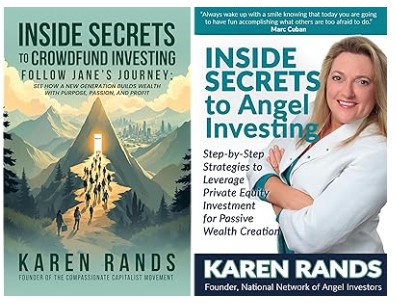
44:10 And I want to encourage people to go and you know, go to our go get the books inside secrets. You can look on Amazon. We got two of them now. One is the deep dive for Angel investors and accredited investors, and the other one is a accredited adjacent for crowdfunding investors and on ramp to that and within the compassionless Academy that will be out soon. You know, if intro and advanced forces and I think that expert scale AI is going to help me deliver on the master classes, the the mastermind sessions, all of those kind of things that people want to come and say.
44:52 What do you think about this deal? What should I look at for this company and that company, it's going to be some good synergies there with all of the investors that will be coming out of this training and after reading the books and. So there you go. It's a pleasure. Thank you for the opportunity and I'll look forward to being of service. Thank you. Talk to you later everybody. Onwards and upwards. Thanks, Alan. Bye. Thank you for listening to this podcast, The Compassionate Capitalist Show, brought to you by Cougar and Capital Holdings with Care Brands as host. You are encouraged to visit the website kugarand.com to learn more about how Karen and her team help investors and Angel groups make money by avoiding investing in deals that suck.
45:42 And how the Kugarand Capital companies and partners help entrepreneurs breakthrough their barriers to capital and live their dream by building companies that can scale and create generational wealth for their founders and investors. If your business could benefit from exposure to our audience of business executives, entrepreneurs, and investors, we are seeking financial partners and sponsors for the Compassionate Capitalist Show to help us take this podcast beyond our 150,000 listeners and amplify the message of the Compassionate capitalist movement by making this a Top 50 business podcast. The Capacity Capitalist Show is available on YouTube, Apple podcast, iTunes, TuneIn, Stitchers, Spotify, Pandora, and Google Podcast.
46:28 Contact us at karenrance.co to learn more. And as a listener, you can do your part of the Compassionate Capitalist movement by subscribing wherever you listen to podcasts and sharing this show with your friends and colleagues. Be sure to pick up your copy of Karen's bestseller that launched the Compassionate Capitalist movement. Inside secrets to Angel investing. A step by step strategies to leverage private equity investment for passive wealth creation. Thank you for listening.