Crowdfund Investing in Real Estate: Can $10 Really Put Your Money to Work?
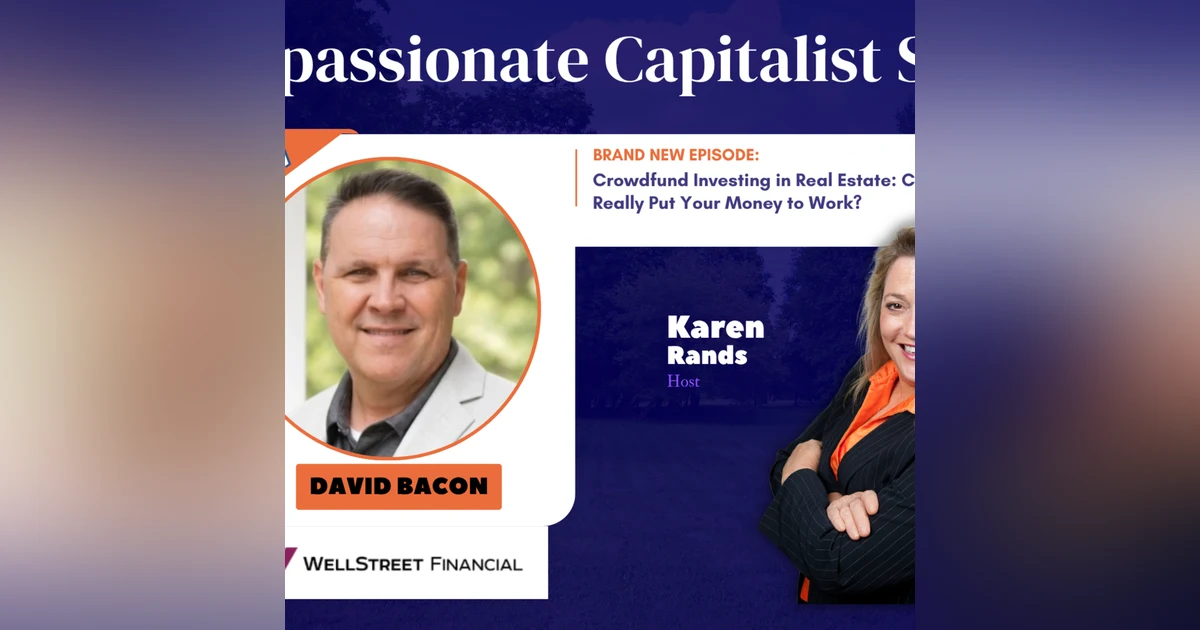


Traditional real estate investing has long required massive capital, strict financing, and the burdens of property management. In this episode of The Compassionate Capitalist Show™, host Karen Rands and David Bacon (Head of Marketing at Wellstreet Financial) explore how crowdfunding and Regulation A are shattering these barriers—allowing everyday individuals to invest with as little as $10.
🏗️ "Becoming the Bank" Through Housing BondsWellstreet Financial pools investor capital into SEC-qualified housing bonds to fund pre-construction infrastructure (roads, utilities, permitting, and site prep). Because traditional bank lending for this phase has grown tight and expensive, alternative capital helps developers build the affordable housing needed by first-time and middle-income buyers.This model allows everyday investors to "become the bank," letting their money work hard for them by backing a diversified portfolio of real estate projects rather than a single property, insulating them from daily stock-market volatility.
🔍 Risk, Due Diligence, and Community ImpactA low investment minimum opens access, but it does not eliminate risk. These housing bonds are active investments, not FDIC-insured savings accounts. Before chasing high yields, informed investors must evaluate:
- Democratized Access: Regulation A offerings allow non-accredited investors to gain real estate exposure starting at just $10.
- Understand the Source: Don’t just look at the headline yield; verify exactly how the capital is deployed and what happens if projects underperform.
- Portfolio Integration: Alternative investments should complement a broader portfolio to balance risk, income, and diversification.
- Dual-Return Potential: Capital can simultaneously generate personal wealth and foster meaningful community development.
- The Time Advantage: Starting early, especially in your 20s, gives wealth the compounding time it needs to grow into a strong financial foundation.
Beyond financial gains, this approach fuels the Compassionate Capitalist Movement™ by driving community impact—supporting homeownership, local jobs, and broader economic growth.
David Bacon is Head of Marketing at Wellstreet Financial, a fintech company offering SEC-qualified investments designed to expand access to alternative investing. Before joining Wellstreet, David spent more than 15 years leading digital marketing for major brands including Truist, formerly SunTrust, Verizon Wireless, InterContinental Hotels Group, and ServiceMaster.
David was drawn to Wellstreet's model because of its combination of investor access, real estate, and community impact — putting investor capital to work financing housing development while making participation available to a broader range of investors.
Wellstreet Financial:https://wellstreetfinancial.com
David Bacon on LinkedIn:https://www.linkedin.com/in/dbacon/
Investors should review the applicable offering circular, risks, terms, liquidity provisions, and financial information before making an investment decision.
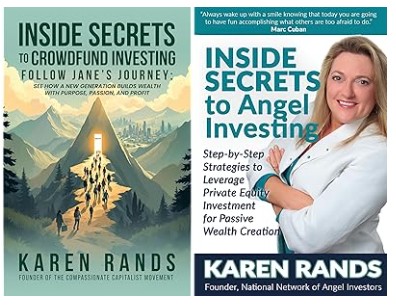
Karen Rands is the founder of the Compassionate Capitalist Movement™ and bestselling author of the Inside Secrets series, including Inside Secrets to Angel Investing and Inside Secrets to Crowdfund Investing. For more than two decades, Karen has worked to expand access to private investing and provide a pathway for everyday people to learn how to become informed angel and crowdfund investors — putting their money to work in entrepreneurs and innovation with the potential to build wealth and share in the prosperity their investment capital helps create.
Get Karen's FREE ebook and explainer videos for the 12 Secrets of Wealth:https://bit.ly/12-secrets-of-wealth
Learn more about Karen, book a meeting, and get her books:http://compassionatecapitalist.me
Want to learn if Crowdfund & Angel Investing is right for you in this economy?
Register and watch the webinar — it's free:https://bit.ly/angel101webinar
Karen Rands (00:01.29)
David, most people believe that making money from real estate means they have to be wealthy and have a lot of extra cash on hand and great credit scores. There's a little known inclusive alternative though. How can our listeners participate with as much as they like, but with as little as ten dollars? What should they understand before they invest?
David Bacon (00:21.782)
Yeah, for for years real estate investing meant that you had huge outlays of cash. You were likely going to be a landlord dealing with tenants, termites, toilets. and then the risk that you had on that was very localized, meaning that if insurance went up or there was a law that was passed, your whole risk profile was then compromised. So with the Jobs Act.
Karen Rands (00:35.372)
Mm.
David Bacon (00:49.834)
And the introduction of alternative investments to retail investors. Investing in real estate can be as little as ten dollars now. Well Street Financial, the company that I head up marketing for, offers housing bonds that invest in US real estate for as little as ten dollars. Now you can invest up to fifty thousand dollars, but the idea that you don't have to be accredited, you don't have to have a lot of money.
and it pays a nine percent return for the first three years and ten percent thereafter. So it's a great place to invest in real estate backed assets while you also pursue other real estate investments if that's part of your portfolio.
Karen Rands (01:37.196)
Great.
This will be the show opening. So I don't know how I okay. Yeah, that was fine. That was fine. I will see it. Yeah. I think I that that got it. All right. So here we go. Welcome to the Compassionate Capitalist Show, where we explore how entrepreneurs raise capital, investors create wealth, and private investment can become a force for economic and community impact.
David Bacon (01:40.843)
Right.
David Bacon (01:44.866)
How did that sound?
Karen Rands (02:08.491)
I'm Kieran Rands, author of the Inside Secrets to Angel Investing and Inside Secrets to Crowdfund Investing, and founder of the Compassionate Capitalist Movement. Today we're exploring an alternative way to participate in real estate without buying property, managing tenants, or making the large investment typically required by a real estate syndication. My guest, David Bacon, head of marketing at Wall Street Financial.
Well Street, excuse me, Well Street Financial, a fintech company offering SEC qualified investments that begin at just ten dollars. Well Street uses investment investor capital to fund residential real estate development. So before joining Well Street, David spent more than 50 years leading digital marketing for major brands, including Truist, which was formerly Sun Trust, Verizon Wireless, Intercontinent Intercontinental Hotels,
And Service Master. David was drawn to Well Street because its model connects investor returns with positive community impact, funding housing in underserved areas. Welcome to the Compassionate Capitalist Show, David. Great to have you on here. It's been a long time coming. We've known each other, I've known your company for a few years, part of going to FinCon and being a real leader in the market when it came to.
This idea of democratization of the capital markets, making these investment opportunities available to people wherever they're able to start. And I and just and having the the steady drip return, it's a big part of what I teach in the Compassionalist Academy to be able to find these kind of investments so that you can somebody can create a balanced portfolio that is where the crowd comes together and pulls their money together and invests in things that matter to them and
the and you know, that, you know, have impact and where they want to have impact. So I'm so glad we finally got you on the show. Welcome.
David Bacon (04:04.781)
Thanks so much, Karen. Great to be here.
Karen Rands (04:08.233)
So let's begin with the basics. When someone invests ten dollars in in a Well Street real estate bond, what exactly what do they own and how is their money used?
David Bacon (04:21.941)
Yeah, great question. So every investor, whether or not they put in ten thousand or excuse me, ten dollars or fifty thousand dollars, all of that money gets pooled into a fund that allows us to invest it in US real estate. And a lot of that goes to the horizontal work, which I'll talk about in a few minutes. Sometimes it goes to another real estate adventure, real estate venture. but that's we take the power of the crowd, the power.
pooled money and we act as the bank.
Karen Rands (04:55.883)
Okay. So what is it that what what do people misunderstand about earning real estate returns without actually owning real estate? Is it does it operate like a REIT where it's invested all over or how does it how do they get attached to the real estate in your your the way your offer is structured?
David Bacon (05:21.185)
Yeah, so the big difference that you'll find between Well Street housing bonds and something like a REIT is that REITs are subject to market volatility. Where Well Street Housing Bonds are a three year bond that is not at all tied to market volatility. Investors put their money in, that money gets pulled, and it goes into things such as the development of the groundbreaking.
the the power, the sewage, the water, all of those things that are really at the they're really a casualty of the tightening credit restrictions from banks. So instead of I need to back up a little bit. I'm sorry, I'm getting a little caught up. Let me let me start that over if you don't mind.
Karen Rands (06:10.473)
Okay, go ahead.
David Bacon (06:13.902)
So great question. Unlike a REIT, which is subject to market volatility, Well Street Housing Bonds uses pooled crowdfunded money to inject into specific real estate products or real estate ventures. And it's actually a portfolio of them. So you might have groundbreaking expenses on one side, you might have a fix and flip over here, but the entire portfolio represents what housing bond investors are investing in.
And those bonds pay nine percent. So to give you a little bit of background on where we find ourselves well positioned for investments, we are currently the United States is currently in a deficit of seven to ten million homes. And it depends on wh which measurement you use, but somewhere between seven and ten million. So you've got all this demand on one side, and you'd think that real estate developers are rushing in to fill that demand. Well the problem
Karen Rands (07:13.397)
Yeah.
David Bacon (07:14.858)
Is in what they call horizontal work or the dirt work. The interest rate that banks charge to do things like add power and water and sewage and curbs and groundbreaking and all of that type of dirt work. the interest rate that banks charge is 50 to 100 percent higher than this the loans for the structures that are going to go on top of it. Yeah, something like 12 to 18 percent.
Karen Rands (07:37.939)
Really?
Karen Rands (07:44.299)
Is that because it's not a hard asset and it's just the that they can't like go back and get the plumbing or whatever, you know, or the pa the paved road. So
David Bacon (07:44.447)
And it
David Bacon (07:52.057)
That's right, the banks consider it more speculative. So we're well positioned to take investor money and inject it into these types of work where the banks are a little bit more stringent, and we can allow new neighborhoods to be built, and then we share our returns with our bondholders.
Karen Rands (07:55.859)
Ha.
Karen Rands (08:15.047)
Okay, so maybe see I make sure I understand how that works. So the actual you're not you Well Street's not doing the actual development. They're funding the development and sitting alongside a bank that's funding the hard assets and then you're funding the soft assets but play in the whole thing, or is Well Street funding the whole thing as if it is a bank, but they charge
David Bacon (08:27.426)
No. Funding it.
Karen Rands (08:42.301)
a different interest rate they charge like industry r injury standard rates without having a higher part for the intangible part of the development. Is that
David Bacon (08:50.488)
Well, in in any type of real estate development, whether not it's commercial or whether not it's residential, banks and you play a role in several parts. It's not just we get a loan like you and I might do to go buy a house. It is there's lending that has to happen well before construction begins. that lending covers things like getting inspections done, zoning, making sure that they're the law is being followed.
Karen Rands (09:01.802)
Sure.
David Bacon (09:19.506)
all of that type of thing comes into one loan. And then the loan, there's other loans as the project continues. What we've done is we've taken our and our bondholder investments and we've injected it into that area before construction begins. And that is really the bottleneck between being able to build new neighborhoods and start to chip away at the demand for residential real estate.
Karen Rands (09:38.292)
Okay.
David Bacon (09:49.235)
And what is currently the status quo for the banks? The banks aren't allowing that, or it's becoming too expensive to do it. So developers are pivoting towards higher margin, higher-end types of homes. So if you wanted to find a you know, right now between $250 $400,000 homes aren't making the money for a developer, and therefore there's not the incentive to build them. We're helping to create that incentive.
Karen Rands (10:17.471)
Because when you put it all together and somebody buys a new home, they're paying what, you know, they they talk about the comps in the market, you know, because of the way other mortgages are or whatever. And so the the the infrastructure that allows that home to be there doesn't get factored into the mortgage value or the appraisal or any of that kind of stuff, but the developer has incurred that expense.
And if it's at a higher interest rate, it costs them a lot more money. So they'd rather get a bigger return on a bigger house than the kind of housing that we're that we're talking about. And so you
David Bacon (10:56.94)
Yeah, they have to recoup that somewhere. And the way that they're doing that right now is to build higher margin higher end homes, which of course is feeding this seven to ten million doll house deficit excuse me, deficit that we have in the in this country.
Karen Rands (10:59.7)
Yeah.
Karen Rands (11:04.233)
Sure.
Karen Rands (11:12.627)
Yeah, and then sorry, it just it's interesting to me because I so I know about like the traditional loans of, you know, there's the pre-construction loan and then the construction loan and that kind of stuff. And I always and I knew roads and permits, I knew all that kind of stuff, but I thought that developers had to come to the table with their a a chunk of their own capital, like twenty percent of what the project is.
And then they finance this bundle. But it sounds like it actually breaks up into even more parts, different kinds of loans.
David Bacon (11:44.076)
Yeah, it really depends on the project, but they can be fairly complex.
Karen Rands (11:47.794)
Yeah. Okay. All right. So the ten dollar entry point is compelling, but the bigger story and in the whole how Well Street exists is how you're able to make this opportunity available to such a broad group of investors. So, you know, I want to the listeners, because you know, I am such a big fan of all the stuff within regulation crowdfunding. And there's a lot of most people know of traditional Reg CF.
But they don't know about the other ones as much, the tr the the difference between what like the regular angels do with the five six B and five six C. But there's this one that's the regulation A that is its own unique beast. So why did Wall Street choose Regulation A as the platform to to deliver this?
David Bacon (12:37.166)
Well, our founder was a very, very big proponent and still is a very big proponent of bringing the accessibility of investments, private credit, to all retail investors. Because and and you've said this before, this prior to the Jobs Act and prior to these type of offerings, these type of investments, being able to invest in a company in its growth stage, or opportunities in a growth stage.
were only available to institutions or the very, very wealthy, the accredited investors. And with the Jobs Act, that's kind of broken that wall down. So when Well Street was founded, it was founded on the premise that the investments should be accessible to nearly everyone. And the same opportunities that historically were reserved for those institutions, those accredited events investors, are now available to everyone.
The second part of that, one of the reasons that I joined Wall Street, was that each of our investments has a secondary benefit. It has a purpose, which aligns perfectly with what you talk about, Karen. The fact is that every investor that comes in can invest whatever they'd like to invest, between $10,000 and $50,000, they know that their investment is going towards some community benefit, whether or not it's
real estate or whether or not it used to be another one we did with senior living, but we are helping communities grow ten dollars at a time. And we're paying a very attractive interest rate, 9% for the first three years, 10% thereafter, with quarterly dividends. So it's very competitive with more traditional types of investment opportunities. This happens to be one that has a great entry point and also a really good
story on the back end of it.
Karen Rands (14:34.897)
Yeah. Well and that's the reason why I I use the word inclusive because, you know, there's it when you get to the Reg A part, particularly similar to Reg C F where there is where where there is any any income can participate. You know, I think it's just the only restriction is really eighteen age of eighteen or over.
And it it levels the playing field because they don't restrict stock market investing and they don't restrict crowdfund investing and you know b based on on income, but they have these gates that you have to go through when it comes to income in these this type of investment, which hopefully that will change someday. Because to me, the true difference between accredited and non-accredited and ability to invest is just liquidity, right? It's just do you have extra money to invest? And then
You know, most people because they aren't familiar with this, have this perception since it's sort of intermingled with what angel investing is, they gotta have a hundred thousand dollars to get started. And the beauty of this is that any, you know, just like you know, saving for a rainy day, you could be put instead of getting three percent on your savings, you could be putting money in on a monthly basis into an offering like what you have.
Whether it's ten dollars or a hundred dollars, you you know, you you you put it you automatically take a hundred dollars and stick it into your savings every month, right? So you have access to it. You could be able to put a hundred dollars into this and be getting nine percent back. You know, that to me is just it it it's so simple and elegant and effective, you know. And and so so by expanding it into non accredited investors.
David Bacon (16:06.572)
Yeah.
Karen Rands (16:21.215)
Do does that mean sacrificing any investor protection like there might be but again a savings is kinda guaranteed. Is there is there a guarantee on this or how what how does that work?
David Bacon (16:32.088)
Yeah, like any investment, there's risk. So in the comparison to a savings account, for example, those are all FDIC insured, where reggae type of investing is not. but we've also gone to some pretty great lengths to make sure that we mitigate the risk to our bondholders. Number one, it's real estate backed. We've already talked about a huge unfulfilled demand for real estate. So that that demand right there is also.
something that helps us maintain the value of this investment. But more importantly, we end up not, we do not as a company look or accept investments that we don't have a 40% equity cushion on. And what that means is that if we have a million dollar investment, we can sell that asset at $600,000 or whatever the number is and still maintain solvency on that particular investment.
But the beautiful thing is it's not simply a single house or a single neighborhood. It's a portfolio of of real estate-backed investments. So it's not a localized risk. But like I said, I I agree with you. I think you want your money to work as hard for you as you work to get it. And another item here, which is one of these things that you kind of go, huh, is
Karen Rands (17:50.122)
Yeah.
David Bacon (17:57.155)
When you put a dollar in a savings account, they're gonna pay you.38% interest the bank will. Yet they're gonna take that same dollar and they're gonna go make 300 times that. So, how do you become the bank so that you can earn these returns? And Wall Street Financial
Karen Rands (18:10.804)
Yeah.
David Bacon (18:22.316)
Allows you to do that with housing bonds. You're just earning 9% instead of 0.38%. Not to say you shouldn't have an emergency fund, but the rest of the money beyond that should be working as hard for you as you did for it.
Karen Rands (18:35.977)
Yes. I I d I that's one of my principles that I or I guess the way I've been trying to get people to understand, you know, with my c my training, the passion list academy, and just sort of approaching this idea of getting involved in crowdfunding is that, you know, and figuring out the different types because different types of offerings of crowdfunding gives you different types of returns. But, you know, it's it's the idea that
You work hard for your money, make your money, let your money work hard for you. Because some people, you know, they have this idea that they need to you know, start a side gig and all that kind of stuff. Now you need it to cover your bills, sure, but they're trying to get enough money together to do other things or to replace their job. And I'm like, my my i i i if you
You know, when it comes to people starting a business, my thing is if you don't know what you're gonna do that is completely going to be unique in the marketplace so that you can make a lot more money than what you do in your day job, keep your day job so you got your benefits, assuming you got benefits with that job, because benefits are really expensive. You don't have them through your company. And then just start carving out that liquidity, things that you could, you know.
And or if you do say, like in the case of Jane, right? Jane in my my book the Insight Secrets to Crowdfund Investing, she figures it out and says, 'cause she'd been saving up for real estate and couldn't afford to buy a real estate, one property. And the reality is, like you know, if you are if you have mortgages on them and you have and you you're making a little tiny money.
And you know, on a monthly basis. And then it takes like I just had to spend twenty five hundred dollars to replace a garage door on one of my properties. And that was like and I don't have a mortgage on that one, but I also end up having to pay about seven thousand dollars altogether in taxes and insurance that comes directly out of my profit. So it's not like where it looks like, great, you're making fifteen thousand dollars a year on it. No, in reality I'm only making
Karen Rands (20:46.431)
you know, $7,000 a year on something like that, right? But on the other, you know, so everything that it it eats into the profit on that. Whereas so she goes and she div figures out how she wants to take keep half of it in her in savings. So she has her rainy day money. She takes the other half and starts putting it into different you know looking at different things and how I what I teach is you do start with something that's income producing. And so
I I use I don't call out your company, but I use it as an example of how she found a project going into her hometown and you know where it was going to be. And she wanted to invest in that and put a put some money in and you know get that percent that in that interest back on that. And so, you know, and it's it's just such a thing that and she figured out that her Saturday yoga or
Yo yoga Zumba class she teaches could be her vacation money, but she didn't have to go do something else and do this other stuff. She could just put her money to work this way and she had a lot more peace of mind, you know, and enjoyed her evenings because she, you know, was was feeling good about how she wa her money was making money for her i you know and all of that. So it's such a crowdfunding is such a great, great empowering way.
for people to take whatever liquidity they have and put it to work and ensure there's risk associated with it. But when you're investing in something like what you offer where it's anchored in the real estate and you know there's this equity piece in there that can hedge your bet, it's just it's it's just a a great way. And I'm I'm glad the industry is starting to catch up and learn about it because of of the stuff you're doing, podcasts like this and everything else that we're we're offering or we're talking about these days.
so
Karen Rands (22:45.267)
So the so when you're doing the nine, we've talked about with the way this bond works. It goes into construction and and building of these facilities how this housing for this target market that is underserved right now. And then and and is it is it through the rest of the investments that people can accumulate that nine percent before there's a liquidity event in the property?
Or how does how does worthy, I mean, how does Wall Street know that they how do they make sure they have the income or there's just enough products pro projects going on that they can pay this nine percent out or is the is the developer paying you a higher percent for the actual construction? Tell give me some of the math logistics of how that works, you know, because there's a it seemed like there are it's not the overall
Healthiness of the investment is sort of the overall success of Wall Street, not any particular project. Is that right?
David Bacon (23:52.759)
That's correct. So the bonds fund a portfolio of projects. And whether or not that project is, you know, so because we have several dozen of these, then if one of them concludes the the developer pays back the loan, we take that and we lend it out to another developer or we invest in another another piece of real estate or something along those lines. But there's there's
Money that's constantly going out and money that's constantly going in. And so that's the that's the nature of why we're we're very, very high on a portfolio and managing the risk through a portfolio than we would be simply taking investor money and dropping it into a single project.
Karen Rands (24:41.171)
Yeah, and so the nine percent does it does it key accumulate in it or is it paid out like a dividend or whatever on a and that's on a monthly or quarterly? Quarterly dividend? Okay. And if somebody says, it starts wants to go look at this, and I should tell people it's well streetfinancial dot com, just set spelled like it sounds, of course it's in the show notes. when there's an alternative investment.
David Bacon (24:50.008)
paid out like a dividend. Quarterly dividend. Quarterly dividend, yeah.
Karen Rands (25:10.559)
Because, you know, I I I'm guessing that you're not the only company out there that is doing this kind of structure. I know there are there's some reg CF platforms that are just real estate based and it's individually individual acquisitions, not like complex ac complexes and stuff like that. So when an alternative investment offers a higher return, what questions should an investor listening here today ask?
before becoming about excited about that yield versus your yield.
David Bacon (25:44.034)
Yeah, I and I think the the the first question I would ask as an investor or what I I
I think is prudent for any investor to ask is where does this investment fit in my overall portfolio? Karen, you've talked at length about a portfolio of alternative investments and that the more the majority of them are either going to fail or at best break even. But then the other ones, the minority of them, are going to hit. You're gonna get your 10x, your one hundred X, and then that whole portfolio performs
Commensurate on how much money you're putting in the ones that that perform versus the ones that aren't. So look at the entire portfolio. If your portfolio of real estate is going to include things like REITs and individual properties and even some alternative investments, Well Street housing bonds have a distinct place in there. So if you're if you're not going to put it into or if you
Put a lot of money into the swing for the fences kind of investment. This is a great place to park and diversify that portfolio with a very attractive return, predictable return, where you're not, you know that that's going to perform over the next three years or however long you keep that in there, while the rest of your portfolio is working in other growth modes. So we don't believe that it's an either-or. We believe it's a but ant.
This is where we fit. And if it resonates with you, then it's a great portfolio diversifier. But certainly look at the rest of your portfolio and and what's going to work for you.
Karen Rands (27:30.663)
Okay, so all right then how so how do how do you v evaluate the projects that you decide you're going to put into your fund?
David Bacon (27:43.532)
Yeah, good. We do quite a bit of of due diligence on all of these. we obviously look at the loan to value ratio, we look at the the the nature of the geography, for example. some of our projects are in high growth areas where new companies are building headquarters or factories. there's a lot that our lending team does before we we invest one dollar in in any of our projects.
Karen Rands (28:12.172)
Okay, so I want to kind of get into the intention because now you the the company or at least the operations of how you how this has how you have you know set this up is several years old, right? So you've you know every company goes through a this is how this is what we think it's gonna be, this is what it turns out.
We got to accommodate for you know shifts in the economy. Right now, as you know, everybody knows that interest rates are really high. so you know what I want to talk a little bit about the impact and the benefit on this, but what when you joke because you moved into here, the company was already running.
What made you believe that their investment model could benefit, could create the financial returns, but also have this, you know, the what they call a double bottom line, right? This measured community benefit. And you know, in and and and go ahead and touch on the idea of the the economic impact that new housing that's in that target range for
a middle class person to be able to purchase or a first-time home buyer to be able to purchase, what does what does the impact that that have on the economy? So your investors, you pick, you've chosen, you picked a good place where there's high demand and high need, and you're doing it in this structure. So it seems like there's such a win win. So I really want you to to talk about sort of your perspective and c and and the corporate philosophy of the founders.
David Bacon (29:58.456)
And and it's a it's a lot to unpack. So I'll I'll start a little bit. Think about just the the general economics of what we're talking about. If if I'm in my mid-20s, recently married, and I want to buy a home today, then the entry level, national entry level is around 400,000, or at least what we expect to pay. So it means that if I can't afford that, me and
seven to ten million others, I'm going to have to rent. The demand for rent is astronomical, which means the amount of money I have to pay monthly for rent becomes astronomical. So while I'm paying for rent, it is it is much less likely I'm going to be able to put money away or enough money away to reasonably purchase a house in say three to five years. I'm going to end up having to wait.
for quite a while. So you can kind of see the snowball effect of the inability for a young couple to go get a starter home or at least something that they can move into without having to put a lot of money down, that kind of thing. The way that we look at it is we develop communities really from the grassroots level.
In the case of Worthy Wealth Housing Bonds, excuse me, in the case of Wall Street Financial Housing Bonds, anytime that we can allow more people into homes and w we see a positive effect on the community. There's more jobs, there's more businesses to open up because more people are moving in. And the list goes on and on. Anytime that you have more people coming in, there's more infrastructure to support them, the schools.
you name it, it just becomes a stronger community when we can help those communities grow. And that's the secondary benefit of housing bonds, at least Wall Street financial housing bonds. And we're real proud of that. We love the fact that when an investor turns around and and puts money into a housing bond, that they know that that money, but I should point out too, there are no management fees here. So if you put if you put
Karen Rands (32:22.294)
Okay.
David Bacon (32:24.31)
a thousand dollars in or fifty thousand dollars in all of that money is going into your investment. So it's kinda nice to know that I'm I'm making a a difference in a local US community. and the alternative and and I've I've seen that I've heard this in the past is you you s you hear in the news all the time about this company settling a a lawsuit or, you know, hey, this one had to pay a fine or, you know, Meta, for example, is
Is paying out the nose. If I'm investing in that company, is my money going towards something like that? Or is it going towards something that I can really look back and tell my friends, by the way, I'm I'm really helping? you just don't know. We're very transparent on that. And you know, it that's one of the reasons I chose Wall Street.
Karen Rands (33:00.445)
yeah.
Karen Rands (33:06.812)
Yeah.
Karen Rands (33:12.95)
Do they get to when they go in and do they see where the projects are that they're that they're investing in? Do they you know, you said it was anchored by these and have a high equity element to it. It do so they can I mean they're not investing in a specific one, it's sort of a portfolio, but they can see there's projects here in Florida or projects in South Carolina or that kind of stuff. Here's the newest one, here's one that's finishing up.
And status of those once they're on the inside, you know, and or and and then one if somebody that's goes to Well Streetfinancial dot com, what do they see as their, you know, I guess, documentation that they can look at to to, you know, make a a f investment decision?
David Bacon (33:57.272)
Well, so when you go to Wellstreetfinancial dot com slash housing bonds, obviously there's the offering circular. all of the information on the company as well as the investment offering is is certainly available. And we're real good about sending out investor updates as we find new projects to come into. I don't know that we, as a general rule, point out the specific project, but we do point out geographic areas or the types of projects.
And we certainly make sure that our investors know that they're making a difference.
Karen Rands (34:31.636)
Okay, very good. So is it, you know, when people are looking at as we talked about, you know, savings alternative, but can they invest through a self-directed IRA or a Roth IRA the way they can in real estate?
David Bacon (34:45.112)
They can through a self-directed IRA. So when you open your account up, you'll simply check that box and it goes in through that avenue.
Karen Rands (34:54.806)
So they just yeah, they so they the and for fo those that aren't listening, it's a it's one that those that are listening here, that's one of those things that you know I I think is terrific because people sometimes, you know, they don't they underestimate the the investment power they have if they've been have been working in corporate America, they can take part of their money from their their four one K and move it into a self directed IRA.
David Bacon (35:01.59)
Yeah.
Karen Rands (35:24.492)
and depending how you if you just if it's another investment vehicle, you know, where it is, because typically when you're a sole proprietor and you're doing your own investment like that, it is already it's after tax and when it comes out of 401k, the tax like well, I'm not an expert on it, but I know that
Whatever the tax structure is, if you have pa have already paid taxes on that money and you invest out of this self-directed investment account, then when it goes back in as income, you don't pay the taxes on the income. You know, so depending on what your the status is of that money, pre-tax or post tax, the return ca is treated the same way. That's what I know. So that's yeah, that's a good way to
David Bacon (36:08.984)
Yeah. Yeah, I'll take your word for it.
Karen Rands (36:13.62)
It's a yeah, I've I've seen it used for people to, you know, unlock and, you know, get more than what a money market would pay them on something like that. So okay, so as we wrap up here, anything you want to make you we didn't cover that we should have you wanna point out?
David Bacon (36:23.459)
Yes.
David Bacon (36:33.654)
No, I I I'm excited to talk to you about these type of opportunities, especially one that at least in my research is is not well known and one that's not
David Bacon (36:52.416)
One that does not require the huge outlays of cash to start in real estate investing. So I I don't know that I can say anything other than it's a great place to to dip your toe in the water if you're a young person looking for a way to get into real estate investing, and it's a great place to park your money and earn an attractive interest rate, even if you are a seasoned real estate investor.
Karen Rands (37:17.482)
Yeah. And are they locked in for that full three years?
David Bacon (37:21.646)
Three years, yes, for nine percent and then ten percent if you want to keep it in after that.
Karen Rands (37:27.486)
Okay. good. Yeah, that's it's so you know, one of the things that I I an example I use, you know, sometimes, particularly for young people that are just getting out of college or recently graduating from college and they're starting in the corporate world, most people, you know, our generation
would stay at a company five years to be able to get the I mean when I joined IBM, you know, they matched. They matched pretty early back then. It was like after the second year or something like that. and the older guys that were had been working there for a while said, put, put it money, you know, put as much as they allow you to, and you won't and you take it right out of your paycheck. You won't even miss it. You'll set your budget up like this, right? And so I had you know, so like five hundred bucks a month.
Right. And you know, what I when I did the math, and it had it was actually
I forget the Arthur Arthur right now that had had he had a podcast and he's big in the angel investing space and crowdfunding had just come out and he said he was talking to the original founder of Seed Invest and he said if if I knew what I knew, Jason Kakonis, he had invested in Uber, he wrote on the wings of an angel, and he and he had said if I could go back and talk to my 25 year old self, I would say, Don't start that first company that I did.
Because I didn't know anything about being in a company. I would go get a corporate gig so that I could learn all the things that companies do wrong when I go to start my own company and I'd get a regular income that I could, you know, stabilize my life. And I would instead of investing in their 401k, because I wasn't going to be there five five years to get vested, I would put $500 a month into a crowdfunding company. And my return after that four or five years.
Karen Rands (39:25.258)
you know, would be significantly more than had I put it into the 401k. And I think and I so I encourage that idea, you know, of of you know putting money into something. And I think in this case, knowing that, you know, mixing it up to put something in, it's going to be out of sight, out of mind, three, four, five years, you know, getting that that nine percent on a on a regular monthly basis, you know, and then if you want to mix it up with an equity play,
That is a great strategy for a young person to start building their nest egg for the future. Because if you think about it, if you put, you know, a couple thousand dollars in every year and it got and like in and it accumulates and you let it ride, it's you know, that is a nice good and and f pretty stable, you know, compared to so many other things right now.
David Bacon (40:15.661)
Yeah, and I would absolutely agree with you, except on one point. I wouldn't go to 25, I'd go back to my 22-year-old self. Because I my daughters are you know, recent college graduates, and the their the 20s are just a golden age of, and I'm not talking about the year, I'm talking about your age, 20 to 30, your golden age of investing.
Karen Rands (40:20.905)
Okay.
Karen Rands (40:24.756)
Okay.
Karen Rands (40:39.862)
Yeah. Yeah.
David Bacon (40:42.569)
It is the time that has the most time to grow in your career. whatever they're going to match in corporate, you take it, it's free money. and to your point, Karen, absolutely find a way to get some money into those crowdfunding investments.
Karen Rands (40:58.624)
Yeah. All right. So my core message in Inside Secrets to Crowdfund Investing is gaining access to investments. is really only at the beginning of what that that the potential of what can do. We're so new. Regular traditional angel investing has been around for eighty years. And there's so many
It's just a it's it's an exciting time to be part and looking and I I swear I wish I did more in my investing and it's been I I love looking at these companies and s and the and the impact, the innovation that's happening and then, you know, having this kind this kind of an opportunity that is core to what people wanna do when it comes to real estate. They want to part be part of solving a problem and
You know, they don't have all of the headaches of direct ownership. So, you know, alone in and I but I also have to say, you know, and you've said it as well, all these investments have risk. You need to p l anybody listening needs to evaluate it with whatever else strategies they might have and look at it. I of course believe that my books do a good job of helping with that. And the Compassional List Academy, you know, really play
you know, spread like lays that out step by step. So because a low minimum minimum doesn't eliminate the risk or replace due diligence. It simply makes it possible for more people to evaluate the opportunities that were once unavailable to them. And that is a larger promise of investment crowdfunding. The entrepreneurs and asset managers gain new ways to raise capital, while everyday investors gain new ways to participate in the wealth
That those investments can create. When it's done directly in a community, like what I'm doing with community capital blueprint, you get that circular prosperity. In this particular case, because we're looking at, you know, across the country, it is an element at a larger macro level to really elevate the middle class to have a way to bridge the wealth gap because they can participate in the same types of opportunities that the most wealthy have been have had advantage of working on and
Karen Rands (43:08.566)
participating in for decades prior to it legally being something that we could do. And even where, you know, the different types of barriers of people based on race or gender or age or income, a lot of that now has been eliminated and it's just a matter of knowing awareness, tools, and education. And we are you're part of of helping me build that in the community and and convey that.
David. So thank you for joining me, helping our listeners understand how the SEC qualified offerings can connect alternative investing real estate and community impact. And I want to encourage people to go to Wellstreetfinancial dot com and check it out. Links are in the note. Links to my books, to the course, all of that stuff are in the notes. And onwards and upwards. See ya the next time.
David Bacon (44:06.125)
Thanks, Karen. Thanks for having me today.