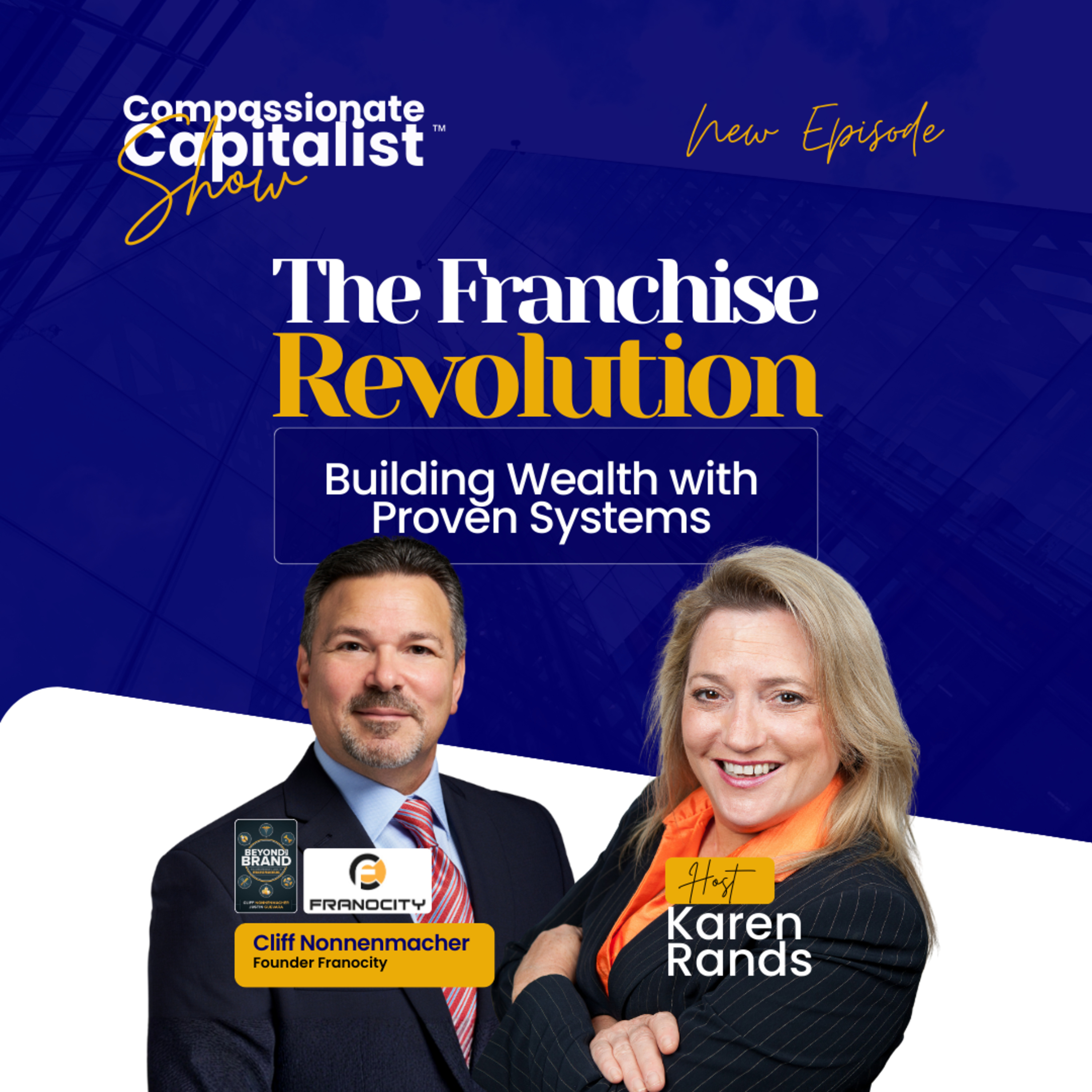
The Franchise Revolution: Building Wealth with Proven Systems with Cliff Nonnenmacher



The Great Debate: Build from Scratch or Buy the System?
Most entrepreneurs face a fork in the road: Do you spend years building a brand from the ground up, or do you leverage a proven system to leapfrog the struggle? This episode isn't just about buying a job—it’s about understanding the science of franchising as a wealth-creation strategy.
I sit down with Cliff Nonnenmacher, author of Beyond the Brand, to pull back the curtain on what it actually takes to succeed in franchising. We move past the marketing gloss to discuss the leadership demands, the risk metrics, and the capital strategies that separate "burnt-out operators" from "successful investors."
If you’ve ever considered franchising as your path to entrepreneurship or a way to diversify your investment portfolio, this conversation is your roadmap to making a smarter, more confident move.
Key Takeaways
The Master Franchise Edge: Why territorial rights and sub-franchising are the "power moves" of the industry.
The Owner-Operator Trap: How to shift from "working in" the business to "leading" the system.
Capital Strategy 101: Navigating SBA loans, ROBS strategies, and the rise of community-based funding.
The Trade Skill Renaissance: Why "blue-collar" trade skills are becoming the most valuable assets in the modern economy.
Mindset vs. Market: Why fear—not failure—is the #1 hurdle to entrepreneurial success.
Episode Chapters
00:00 – The Great Debate: Startups vs. Franchising
03:54 – Master Franchising: Owning the Territory
12:01 – Navigating the Franchise Investment Landscape
21:17 – The Owner-Operator Dilemma: Managing vs. Doing
32:02 – Beyond the Brand: Actionable Insights for Investors
37:01 – Financing the Dream: SBA, ROBS, and Capital Hurdles
49:44 – Community-Based Funding: A New Way to Scale
01:00:34 – The Future of Business: The Importance of Trade Skills
About Our Guest
Cliff Nonnenmacher is a premier voice in franchising and the founder of Franocity. Having sat on every side of the table—from sales and franchisee to Master Franchisor—he now advises builders and acquirers on how to scale fearlessly.
Connect with Cliff: franocity.com
Get the Book: Beyond the Brand: The Entrepreneur's Guide to Fearless Franchising
About Karen Rands
Karen Rands is the founder of The Compassionate Capitalist Movement™. As a Venture Catalyst and best-selling author, she is disrupting the status quo by equipping a new generation of "Compassionalists" to bridge the wealth gap through private equity and small business investment.
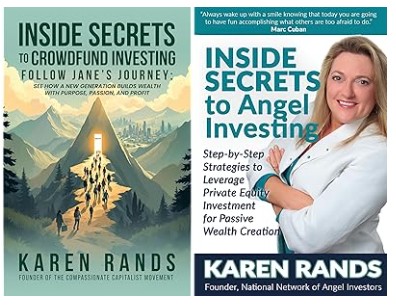
Bridge the Wealth Gap: Get Karen’s Books on Amazon: https://www.amazon.com/stores/Karen-Rands/author/B073R2N1TL
Join the Academy: The Compassionalist Academy™ (Sign up now for 25% off the annual license!) bit.ly/CA-prelaunch
If you found value in this episode, please like, subscribe, and share it with a fellow leader ready to disrupt the average.
#CompassionateCapitalist #Franchising #WealthCreation #CapitalStrategy #EntrepreneurMindset #VentureCatalyst
0:06 The Compassionate Capitalist Show empowers entrepreneurs and investors alike to create wealth with passion and purpose. Join Karen Rands, a best selling author, for insights on Angel investing, crowdfunding, business growth, and wealth creation. As a seasoned entrepreneur and investor herself, Karen engages in dynamic conversations with industry leaders, successful entrepreneurs, seasoned Angel investors, and venture capitalists as they share their proven strategies and lessons learned. Once you listen, you will understand why this podcast is ranked in the top 2 1/2% globally. Subscribe and share and be a catalyst for the compassionate capitalist movement. There's no giving up and a little in back and you must keep an open mind and you try your best just to leave your track and do not fall too far behind.
1:00 Regret is for the faint of heart. In the end, it's all the same. Take what the wise I've got to impart. These are the principles of the game. The principles of the game. These are the principles of the game. Welcome back to the Compassionate Capitalist Show, where we explore how smart entrepreneurs and informed investors create wealth, opportunity, and impact together. Today's conversation is one I'm personally excited about because it hits on a question I hear constantly from both sides of my audience, entrepreneurs and investors. Should I start a business from scratch or should I buy a franchise?
1:46 Or for the investors, is franchising a real a real asset class or how do I assess the opportunity? When you're thinking about owning A franchise yourself or you're looking at franchising as a scalable investment strategy, today's guest is going to completely reframe how you think about this industry. There's a big difference between building a startup that is a market participant, where you're fighting for visibility in a crowded space, versus building something brand new as a market maker with all the risks and unknowns that come with that. There's a value of being a market participant if that's the kind of business that you want to be in and having the systems and the brand. And much of what we're going to talk about today that franchise, the whole concept of franchising or as a franchise brings to the table, you get a proven system, collective intelligence, brand strength, operational playbooks and a dramatically lower failure rate that my guests shared with me earlier, about 17% compared to a much higher failure rate for first time entrepreneurs.
2:52 But franchising also has its nuances, legal frameworks, funding strategies and pitfalls that most people don't see coming. And that's why I wanted today's expert on the capacity capitalist show. My guess is Cliff not a not a mocker. The founder of Fran, Fran, it's not going to make now we've gone through this. This is so funny. We went through this. I practiced and here I am getting tongue tied. It's the subliminal like, oh, don't do it wrong. Cliff Nonimacher and founder of Phrenosity. That's right. OK, and one of the most respected voices in the franchising industry. Cliff's entrepreneurial journey started at 8 years old selling golf balls at local golf courses. And at 19, he created one of the first food delivery subcontracting businesses for McDonald's decades before Uber Eats.
3:43 He went from early ventures on Wall Street, becoming an investment banker at what was Solomon Smith Barney, now Morgan Stanley. And in 2003, he made a massive pivot into franchising, acquiring the master franchise rights for New York and Connecticut. And since then, he has owned, operated, scaled and developed brands across the US and internationally, from Cartridge World and a personal training institute to Pure Clean, May Ride and a few others that you would recognize. He's also the host of Pursuit of Profit, one of the most listened to podcasts on the franchising sector. And I don't even know if this is the first podcast since his book became a best seller. But beyond the brand, the Entrepreneur's Guide to Fearless Franchising is really creating a buzz. He has personally guided hundreds of owners and investors using real data, real operating experience, and no fluff approach that cuts through the noise. So welcome to the Compassion Capitalist show, Cliff. What?
4:46 What an intro. What an intro. Thank you, Karen. Really happy to be here. Yeah, same. It's good to see you again. Thank you. So let's start at the beginning because your story is remarkable. You went from early entrepreneurship to Wall Street to becoming one of the top master franchisors to franchise developers in the country. So take us back. What was the moment when you realized franchising was the path that you would use, that you could build wealth on only for yourself, but for others who wanted to have a proven system to follow? Yeah. So that introduction, as you quite rightly mentioned, was that 2003 pivot from an investment banker and then saying, hey, I'm going to become a franchise, a master franchisor, which is an interesting play because most people would not do that. Most people just start with a small investment by a single unit and see if they like it.
5:38 I ended up going very high. Master franchising is 1 level beneath the franchisor. So for the audience like what? What is the difference between a a master or a franchise? The master has the rights to the entire territory as you stated 2 states which is massive. There's a huge investment, but I also have the right to sub franchise so I could sell Karen a location somewhere in my territory, keep half of your franchise fee, support you and keep half of your ongoing royalties. So that's where a master is very similar to the franchisor is that I share a royalty collection where a franchise only pays royalties.
6:22 The master collects royalties. That's the differentiation. So there, let me make sure I understand that. So there. So when a franchise is set up and they have, do they all have masters and then so OK, so but there's like a three tiered system if they have. Masters, I'll give you the hierarchy. That's a great statement, right? So the hierarchy would be from the top to the bottom. The top is the franchise or we created the concept. We only the IP. We have a federally registered mark. The mark is ours. It's our system, right? It's our brand. Next would be the master. The master would buy a county, a state, a country.
7:03 When you think about AUS based brand, how does AUS based brand expand in Germany? They would sell Germany to a massive investor group and let that master expand the brand in Germany or overseas. So master franchising is used heavily internationally, which brings us to Cartridge World. Well, how did you get the master? It's from Australia, so it's reverse mastering. They're from Adelaide, Australia, So I bought the state of New York and the entire state of Connecticut with my business partners. OK, so franchisor, master franchisor. Next would be area. Someone that may own a county and they're developing multiple locations. Under that would just be a multi unit owner. Maybe 3 to 5 locations for a multi unit and then a single unit owner.
7:55 So you either own a unit, you either own a few units, you either are developing an area like a county where you own several units, You're either a master or you're the franchisor. That's kind of the hierarchy of franchising, in my opinion. The single greatest wealth creation methodology ever built on the planet. It's almost a trillion dollar industry. It's massive. For to be the masterpiece, the level of franchising in general. I think I think franchising is the single greatest methodology ever created. Sure. For what? For creating wealth and being a business as just an ordinary person. Yeah, we're going to yeah, we're going to dig all into that. It's but you triggered something that I want to ask about.
8:38 It's it's interesting you prepare all these questions, but then we're having a conversation, which is what's interesting because you know, we want to that's the whole reason why the people listen to this is because you just don't know what's going to how, what little golden Nuggets are going to come out. So when because this is this kind of goes to that whole like with somebody starting up a franchise or they're starting a business and you know, I and certain businesses, well, let me ask do are there certain businesses or sectors or industries that don't fit a franchise model? You know, I'm guessing if you're inventing something new and creating a whole new market, but then it's still, you know, sometimes those new markets or the new solutions, a way that it's delivered is the franchise.
9:23 It's becomes the unique franchise. So you know, I the reason why I'm asking, I was leading into asking that is like do when you're, if you're, let's just say traditional types of franchises, like do you decide when you like? OK, I've got three locations that I'm running as a small business owner and now I think I want to franchise it. I need to set up the levels like you just talked about or do it do. Can you go back later and add master and whatever you want in there and it's not too disruptive or do you have to have that blueprint from the beginning? Do people choose because why would a franchise or not have master franchising? Yeah, well, they don't, because they don't want to give up. Royalties are the name of the game. So no one wants to give up royalties, right? You don't want to split, you don't want to give up 50% of your royalties and franchisor can get a 10 to 15 time multiple on EBITDA.
10:20 You want to collect that royalty, it's worth a fortune in the future for future development, expansion, acquisition. So why would you not want if you're a franchisor, why wouldn't you Fran create a master? Because you don't want to give up your royalty collection. You want to control the brand, you want to control the support, you want to control your distribution channel. You want to control where you develop and you want to keep 100% of the royalty collection, which is the lifeblood of a franchisor. That's how they make their money. OK, so within that same context, but clearly if you if somebody in the cartridge world example you're in, it's out of Australia, they don't have feet on the street here.
11:01 And so they're, but they're looking you as a as a have to put a lot of money in to cultivating and developing it, paying for. That's right. You're, you're spending money that they don't have to spend. So it's the I'll give up a piece of my profit because this other person is going to invest in it. And then I guess it goes contractually on what that the requirements are. That, that's exactly right. They're bringing in a ton of cash on one transaction. It could be hundreds of thousands to obviously millions when you're buying massive territories, usually pay per capita.
11:43 We're talking about something that is not that common. It just happens to be how I entered. And that's kind of what I said to you. It's not a common way to enter a franchise. And most people, if you, yeah, if you lined up 1000 people and said, what was your first introduction to franchising, they'd say, I bought 1-2 units and I scaled it like period. So this is a really unique way of entering franchising. So I prefaced that. But you're right. The franchisor in Australia brought in a ton of money. They, they got me, my team, my business partners. We then spent money to acquire leads so that we could close more deals and sell more locations. Part of the agreement is that you must own a flagship location. So if we not only put the footprint in there, right? So you think about the force multiplying effect of selling masters throughout a country and demanding that each master perform these certain roles and make certain investments. And meanwhile back in Australia, they're like, we're just bringing the money in.
12:40 We haven't spent any money yet, but now we we need to hope that we hitched our wagon on the right people. Sure. Do we have the right people though? And of course there's language in the contract. There's a development schedule and they can terminate if you don't perform. They can take the territory back, sell it again. Very common. So sticking on the on the investor side for a moment, are there key metrics or indicators that you think when you, because you advise both sides, somebody that's investing that? We'll talk a little bit about fronosity for a second. You know what, what you're, what are you advising? Are you advising the people wanting to go into masters, starting up a franchise?
13:22 All the above? The core competency is helping an investor navigate franchising to identify the right business to buy right the right franchise. So I only focus on franchising when it comes to advising clients. So again, the core competency is I have someone right now losing their job to AI. They have a couple of 100 liquid. They have an appetite for maybe 3-4 hundred grand of SBA debt and they want to buy some brick and mortar or a non brick and mortar brand that could replace and exceed their income, which was 200 to 250. So that's like that's happening, by the way, all day long now I'm losing my job to AI or I feel like I'm not going to be here much longer.
14:12 And that's what we're hearing a lot and I'm trying to get ahead of it. So this is the way the call will go. Can I keep my full time job that I'm probably not going to have much longer and get this business going on the side so that if they do terminate me, I could transit? Yes, it's a very, it's almost a multiple time a week conversation that we're having with people. PA, people are very fearful right now of AI and a lot, especially in the tech space, especially in any industry where there's repetition, redundancy systems, I mean AI agents and writing code and doing certain things that AI could do better, which is crazy. So that's a common. So yes, secondary what we do is we help people that have a great idea become a franchisor.
14:57 OK, All right, so I get calls all the time. Hey, I heard you on the show. I, I have this, I have a great idea. My unit economics are incredible. I could scale this thing across the United States. I don't know how to do it. I don't know where to begin. Can you help us? And we do. And we do it by leveraging our third parties and team, you know, attorneys and law firms because it's a, it basically starts with a legal document. Right, right. Which is the FD. Right, right. We're going to come back to that. Is there are there any key metrics or indicators when you're having that conversation like you just talked about with somebody that has this level of liquidity that says what kind of franchise is good for them? Like say, does a, you know, if somebody isn't a doctor or anything like that, can they, would it make sense for them to buy a, an, A emergency clinic, you know, that kind of a thing that would be, you know, a pretty profitable franchise or that kind of a approach? Yeah, it the the background, the skill sets, the risk tolerance, the income needs, the geography of where they are, it all plays into it attitude, right?
16:06 Are they coachable? Are they going to follow a proven system? Are they are they too entrepreneurial? That's a problem. That's a problem. It's like, wait a minute, it's a problem. You know, if Elon bought a franchise, he would change literally everything about it. It would be disruptive. It would probably be better, but it would ultimately be short term, very disruptive. Long term would be a win, I'm sure. So you can't be too entrepreneurial. You got to follow the model, stay within the curbs, right? So it's that's that's that structure. So I look for that. I look for likeability in a client. Is the is the brand going to like the investor, the buyer, the operator? A lot of people coming out of tech positions, you know, some of them like to be alone in a cubicle or in their Home Office.
16:51 They don't want to communicate with a lot of people right there. Social introvert. That's not going to work and you're not going to be able to lead your team. Leadership is is critical. We always say, does the person have energy? You know, yes, no. Can the person energize others? Yes. No. Can the person execute Right. And can the person is there? Are they edgy? I got this from Jack Welch. I think it's brilliant. It's the four E1P principle, right? Do you have energy? Can you energize others? Can you execute the business? Are you edgy? And you can make difficult decisions like firing people and P for passion. Are you passionate? Some of the IT folks, you know, they lack a lot of them and the brands are not going to get excited about them and neither are their employees.
17:38 The employees don't follow like a deadbeat. The employees will follow energy and execution and someone that believes in something and has a vision for the company. Even if it's a small company, it doesn't matter. I don't care if it's a little subway. The employees need to understand who's running this thing, what's what, what is the mission? What are the goals? How do we treat the customers? What's acceptable, what's not acceptable? And as you could tell by walking around the world and doing business, there's no more leadership at any level. Customer service sucks. Everything's broken, nothing works. Bathrooms, it's like crazy. We need leadership and that even at the small business level, and that's what we look for, is someone that the brand's going to say, I love this person.
18:20 Where did you find this client? I wish I had a hundred of them. And that's what we're really good at. We're really good at that. Because I heard a long time ago from an old mentor, you have to cherry pick. Don't Polish the pits. And it's so true, so true. Yeah, that's a good one. It is. Polish the pits. That's right, you got a cherry pick. Don't Polish the pits. So you talked a a good bit about, you know, what makes a great franchisee, right, Somebody or, or you know, the, the characteristics of that is and, and a lot on the personality traits, but do those differ if somebody's buying or versus starting a franchise? It seems like the edginess or the innovation or the forward thinking this, you know this because in startups, one of the challenges you have a startups and for investors investing in startups and startups being startups is that they have, it's the hunt, right?
19:21 They have they love the building part, but they struggle to transition to the management, leadership, organizational part. And investors love that dynamic, you know, the charisma of that visionary entrepreneur and then but then struggle with wondering why they have, you know, a revolving door of their team and they can't continue momentum as they get, they start hitting a wall of, you know, millions in revenue. It's harder for them to scale. So it sounds like it's somebody that has that but is more grounded as the best person to leading a franchise. When we're working with someone that we feel it it, they don't check a lot of the boxes that the franchisors are looking for in a partner.
20:08 It's a partnership, right? You're you're buying, you're paying me a franchise fee. I'm giving you my blueprint, my road map to be successful. And I'm letting you represent my brand, my moniker at the local level like you are now a direct reflection representation of my brand. Is that the right person to do that? And that's why I tell everyone, franchises are not sold. They are awarded to qualified candidates. And a lot of people enter franchising with a consumer behavior. And the consumer behavior is he who has the gold rules, right? No, no one cares about your money. No, no one cares about your check, right? They care about you.
20:49 And are you the right fit for this culture, for this brand? When we identify that someone doesn't check all those boxes, we have a chat with them and explain you are not a salesperson. You want to buy a heavily outside sales organization. So what happens is a lot of technology people, they fall in love with, let's say Signorama as a brand. Just giving you an example of something you might know and your audience might know. I'm not endorsing the brand at all. So let's just talk about a Signorama, right? You're dealing with channel letters and box signs and CAD and software design, right? You're bending neon and glass and you're illuminating open signs and you know, Whataburger and all these different brands sounds really cool.
21:33 Here's the problem. All IT people love it. All engineers love it. We're dealing with equipment and and all this type of stuff. Are you going to go to a networking event at 7:30 PM on Thursday night? No. Are your hands sweating at the thought of me even bringing that to you? Yes. There's your problem. People love a business. They don't love what it takes to grow that business. And that is the disconnect. That's the disconnect that we identify upfront. You are not a salesperson, you're not charismatic, right? You can't close, you're never going to grow. You're not a rainmaker, You're never going to get this thing off the ground. So you could go play with the software and play with your equipment because you're about to go out of business. So we say to them, you need a Rockstar salesperson. Are you willing?
22:20 It's going to be 6 figures. Are you willing to make that investment? So my total investment is, is more than what they disclosed in the FDD. For you, it is because you can't sell. Yeah, OK. And then at that moment we start having a real conversation about, OK, hire the skill sets I don't have. And that's the conversation. Here are the skill sets you don't have, OK, you need to hire those skill sets. If you're not willing to do that, not going to happen. Yeah. And that's, you know, part of what I use in my coaching for, you know, entrepreneurs raising capital and and attracting capital. Is that whole kind of a concept of the E myth revisited. I'm sure you know that Michael Gerber, right? And it's like you, you have to know enough about all of the jobs that you need to in order to be effective in your organization.
23:07 So you can know if they're doing the job well, right? But but part of loving what you're doing as a business is and being able to do it is not by inevitably you have to go do all those things. And if there's something that you hate, you end up hate. Like in the case of, for those who don't know, Emeth revisited, it's a pie maker and she loves or he whatever loves making pies. But because they have to do all the numbers and they do all this other stuff, they end up hating making pies. And so it's part of building a team so you can work on your business and not always in your business. And that leads me to the question that of the owner operator concept, right, that I guess a master has to do.
23:52 Like we've been talking about, I guess, somebody buying a franchise and having to do these things and think about the team they're going to build in, you know, their own skill set and stuff, which is, you know, part of all of any business. But there is a definite investment strategy that says, I'm buying this and I'm going to hire the right people to run it. And in some cases I might sublease like you're talking about. And an owner operator earn their business as they succeed at the business and, and they, they start, I had heard this where the, the, the, the master will still own the brick and mortar of it. Whereas, you know, as a leasing thing.
24:34 But the franchise that they sub sold it to develops the business enough that they earn the right to actually outright own the operational side of that. Is that still something that people look at and do? In my world, buying any real estate or the franchisor owning dirt is non existent really. But that story is, you know, kind of a McDonald's thing, right? Where and, and yes, other large brands have tried to replicate that play where McDonald's will own the dirt and the franchise will own the brick and mortar. So the parent company owns the dirt and then you're building brick and mortar on top of it and off you go as a McDonald's franchise. Other brands had tried replicating that real estate kind of strategy.
25:22 So you're a franchisor, but you're really in the real estate business and hamburgers and French fries is just your product, your vehicle. And not a lot of brands have that kind of capital and the ability to just be a land Baron, you know, like like McDonald's mean multinational multi billion. So most brands that we're dealing with, they're going to lease the space. Let if you take the Super set of brands that we deal with, first of all, we have a ton of non brick and mortar. So there's no location at all. None. They're operating out of their house, a small office, an industrial park, really cheap space. Then you have your brick and mortar, which is never owned again. It's usually leased and it would be a maximum, you know, 2500 square feet. And when I, and I'm referring to typical everyday deals, $1000 trampoline park is not an everyday deal, right?
26:09 It's a four $5,000,000 investment for a, you know, trampoline park at a 30,000 to 50,000 square foot of space. So everyday deals are going to be your Supercuts, your Great Clips write, your UPS stores, your Makos, your Meineke's, your oil changes, your pet areas, your you know, your dog boarding, you know, and your beauty, your vanity, your nails, all that stuff that you see. I mean, enter a strip mall. That's what America is, is funding. Go to any strip mall in America and tell me they don't have a nail salon in it, right. Go to any strip mall in America and look, just look around. You'll see massage therapy. Look around, you'll see you'll be within shooting distance of a pack and ship location. You'll be you'll always be within distance of hair, nails, makeup, beauty, vanity, always within there. Those things that they are the thousand 1500 square foot spaces that feed off of the the main.
27:03 Maybe it's a grocery store. The anchor tenant? Who's the anchor? Is it a Home Depot with TJ Maxx? Is it a grocery store? Is it LA Fistas? You have your anchors and then you have just a ton of 1500 square foot spaces. OK, so the, I think we're in the, I guess, you know, because there's all different kinds of price points for a franchise buying a franchise, right? Years ago, I had attended a conference or a trade show just to, you know, get a foundational to know what was out there and understand more about franchising. Because I, I had, had an investor that I had at a company I was working with that I couldn't connected them up to an investor and the investor came to the table was supposed to be closing. Like we were like at that point, but I had kind of the final hour decided to go buy a franchise instead, you know, as an investment.
28:00 But he, you know, it was one of those where he like he didn't want to be getting, like I said, say Dunkin' Donuts didn't want to be getting up at 4 O clock in the morning to go buy Donuts. And on the flip, I mean to start making Donuts. The flip side of that was somebody that, you know, decides I, you know, I want to have a donut shop, but I can't afford a Dunkin' Donuts. And it's it, there's a lot of money to start your own, but there's this, you know, premium because of the brand, the system, the operations, all the things that we've talked about is that they, so they find a partner or an investor that will come in and underwrite the, the purchase of the franchise. And they, that's where I saw the owner operator means that like they, they, they don't actually own it yet. They operate it till they have the ability to own it. I see, I see in my world they're straight up owning the franchise.
28:57 So client will come to me, they're going to buy it, they're going to deals. Deals are funded a multitude of ways, cash, home equity, SBA retirement plans under the ROBS tax strategy. All right, there's a it's a hybrid old ways to get a deal done. But whenever in a situation, you know, that you described, other than a manager wanting to buy out, you know, the franchise and say, I'm going to take it now you have that situation. One of the things I tell clients are you're using like very interesting words. I and I love the way you, you speak about you're very you're very specific in the words that you use. So when we when you talk about like you mentioned, Michael Gerber, the E myth, OK, the number one issue that we deal with is that people say I'm going to buy a business when in fact all they do is buy a job, right? Because they actually make sandwiches, they actually groom dogs, they cut people's hair or they're doing whatever their brand is doing.
29:50 That's an employee. That's an employee. So any business owner that says, oh, I'm a business owner. I own a franchise. What franchise do you own? Oh, I own, you know, Supercuts. And it's like if you're actually cutting hair, you don't own anything. I'm I'm sorry, you just bought yourself a job because you're never going to scale it. You're never going to go anywhere. You're never going to create wealth. You're never really going to do anything if you're standing on your feet all day cutting someone's hair, like it's not never going to happen. So what we try and explain to people is we want you to look at businesses that are profitable, fully burdened by payroll, meaning not you, right? I want you, the owner, to be replaced with a manager. I want you managing the manager.
30:31 I want you working on the business, not in the business. Simple words, very difficult for people to do. I actually, I'll tell you a quick story. It was actually a remarkable story and it's recorded on my podcast. So he's a, he's a three time national pool champion. This guy has been an appliance repairman while playing pool for 17 years. OK, he easily could have just went out on his own and started his own appliance repair business. But he didn't. He ended up buying Mr. Appliance. Again, 17 years of appliance experience. He ended up buying a franchise. He saw the value in the franchise, but listen to this story. It's remarkable. So he buys the franchise, the franchisor gives him guidance, and one of the pieces of guidance is you are now one of our franchisees. Stop driving the van and stop repairing appliances. You're an owner now, and you need to embrace the methodology of working on your business.
31:29 Not in your business. Oh, yeah, yeah, yeah, yeah, of course. Of course. That's why I did this. I want you to tell me how to become successful and create wealth and provide for my family. What does he do? Drives the van, fixes appliances. Listen, this is like crazy, goes to the franchisor. Several months later, I'm about to file for bankruptcy. I'm failing. What do I do? Franchisor repeats. Stop driving the van and start leading your team today. That guy does over 5 million repairing appliances in Michigan. And for anyone that cares about a story like that, it would be on my pod. As you mentioned, pursuit of profit. Remarkable story. I just recorded it. It didn't even post yet, but but it will because we recorded it a couple weeks ago.
32:13 So it should be up there soon. That's the that mindset shift, believe it or not, sounds so simple. To become successful, all I have to do is stop being an employee in my own organization. That's just easy. Yeah, go ahead, do it. You can't do it. People can't do it because they were raised by someone who said if you want something done right, do it yourself. It's the stupidest, worst advice you can ever give another human being. It's suppressing, it will keep you poor, it will keep you miserable, and it'll keep you working till the day you die. It's a horrible advice. Wow, horrible advice. OK. We will come come back to the financing side of this thing, but I want to make sure everybody knows how to go and find it. Go to your website.
32:55 It's frinosity with, but it's spelled with an O in the middle. So it's FRANOCIT y.com OK, so Fran like franchise O and city. OK, like velocity, but fronicity OK, and take a few minutes to talk about your book, your best selling book, because what all what all kind of golden Nuggets ways is it intended for the the person that's going to buy the Fran, a buyer, the franchise, a master building it or what What what's your audience there? Book, books, bestseller on Amazon. Beyond the book, Very, very proud of Beyond the Brand. Exactly. It's yeah, you can't see the yeah, Beyond the Brand on Amazon right now.
33:36 It ended up hitting multiple categories. It got multiple awards as a bestseller in that in the category, of course, I'm not competing with, you know, Mel Robbins. We're talking about, we're talking about entrepreneurship, franchising as a category. We're very proud of the book because the book wasn't, you know, click bait and giving people cliches. The book was actually written someone to have a blueprint to be successful. Who should do it? How do you do it? How do you fund it? Massive section on funding from unsecured lines of credit all the way up to Helox, all the way up to SBASBA Express, SBA 7A. It's all in the book on how you can fund it. A big section on Rob's, of course, because Rob's huge.
34:16 There's a section in or about not working in your business. What does that mean? Hire talent. How do you retain talent? It goes into incentives, it goes into abandonment clause as it goes into claw back provisions, it gets very granular granularity and words that you would find from a private equity firm, right? So not your, it's not a normally written business book with fluff and images. I mean, it doesn't have an image of fear saying face everything and rise. It goes through why you fear, right? You know, it's, it's like all the stuff I see. It's like, that's not helpful. I've read all these business books from competitors and it's like that.
34:57 That just wasn't helpful. You know what I mean? Like, that doesn't really do anything for me. You're stating the obvious, like you're sharing some anecdotal stories, but that's really not giving me clarity. It's not giving me the ability to execute. It's not giving me anything actionable that I could put that book down and say I got it, I got it. I have clarity. I know who to call. I, I know how I'm going to do this. I know I'm going to keep my career. I know how I'm going to get my spouse on board. I know how I'm going to fund it, right. Oh, by the way, there's, I don't know, 24 mandates for negotiating a commercial lease. When I was with Cartridge World, I, I personally negotiated every lease, right?
35:39 These are some of the toughest landlords in the world. New York. I mean, it's unbelievable, but a lot of people don't realize personal guarantee rest, they don't understand term, they don't understand escalation clauses. A lot of them don't even understand that the space that you're looking at 1000 square feet is 1325 square feet. Measure it. Like, I'm serious. This stuff happens every day. It's like, how big's this space? OK, you know, trust but verify. Get someone in there. Measure like little things like that. Can you imagine paying $100 a square foot on 200 square feet that you didn't even get? So like little thing. I always say landlords have rubber rulers, right? It's just a rubber ruler. It moves, never to their detriment.
36:20 It moves anyway. The book is chock full of ideas at big section on fear as well. Fear has killed more deals than failure ever has and it will continue that way cuz we live in a culture now where everybody wants to be half pregnant. Nobody wants to offend anyone. We live in this weird time where no one is really taking the chances and the risks that they should be taking, especially for our youth. Our youth should be putting all the chips in the center of the table. I mean it like that's your window. Do it. So what? You failed, you learn, you get up, you have a long runway for recovery. Not a big deal. Like in the scheme of it's like, it's like you and I talking about a stock market crash in the 80s. It looks like a tiny little blip on a graph at this point. So it's just take so think that's what the book gets into a very granular, very detailed.
37:12 Again, was super proud of it. Yeah, but I can see there's some serious passion in totally what you're talking about. And you know, I can feel the decades of experience and of that you wanted to put on paper the and all of the good, bad and the ugly of what you have experienced in your own ups and downs and trials and tribulations and successes and failures. I mean, all of the, the bio is all about the successes. And you know, and as you as you have, you know, advise lots of companies that have made you know, or lots of entrepreneurs or future franchisees, you know how you know what all of all of that you just shared all of that. It would like really, I can really feel it and I could I think it's going to be a well, obviously it's a great selling book, but I would it makes me wish that I could. You know, sometimes you go back and talk to your younger self and you say what should be done and the path that I took on, you know, being a disruptor to change the status quo of how people think and what they do.
38:19 You know, I'm not inventing, you know, a new rocket, but it's it's challenging. And sometimes I look back and say, you know, I probably should have bought a franchise instead or hey, bought it, made a bunch of money and use that to do the thing that I'm disrupting on. That's right. So, OK, so let's talk about the financing side of this stuff, right? Because I think, you know, do it does SBA favor franchise acquisition? And we had talked previously about a situation that I had experienced with a guy that had used his retirement because that franchisor had this weird thing where they didn't want SBA to pay for the franchise itself, you know, the the the contracting side of it. So then when he went to try to get the SBA loan to pay for the build out in order to be successful, he didn't have the same assets that he had before to qualify. So talk about that and some of the ways that entrepreneurs or folks can franchise can finance these. But also throw in there because I think family offices or aggregates of they're not actually a straight up private equity funds, but they're an aggregate of a few people that come together to create the funding for master franchise. Right.
39:47 Yeah, I, I see that that last comment, I see that on larger deals like multi million deals, we represent a brand called Sky Zone. Sky Zone can be between two and and 5 million. That's the parachuting thing. No, it's the trampoline park. The trampoline park? Yeah, trampoline parks, you know, huge deals, lot of VC money, lot of private equity, a lot of all of that, right. Someone will say, I have this idea. They'll go to the street, they'll gather some assets because they're not buying one. Like they'll buy 5, they'll buy 10. So you talk about the, you know, this could be a forty $50 million deal when you own ten of those things. Why do people do it?
40:29 Because they net like 8850. That's why they do it. So the net is incredible, the attendance is incredible, the unit economics of the brand is incredible. It's simple. It's highly scalable for someone with capital. A typical deal is going to be an SBA Express and an SBA say, right, because 7A lends up to 5 million as you know. But that's very, very typical, whether it's brick and mortar and non brick and mortar. We're doing SBA loans. We do equipment leasing because in non brick and mortar we could get an equipment lease. We could maybe use some liquidity that they have on hand to cover the franchise fee. As I said before, a lot of our deals are a bit of a hybrid. How are you paying for the initial franchise fee of 50,000 cash out of my checking account Done. What are you doing about the vehicle and the equipment which is totaling A100110?
41:21 I'm going to get a lease on the van and I'm going to get an equipment lease on the equipment. Got it. OK. You know, how are you doing this now? So we asked them, oh, I'm going to go get an SBA express loan, Maxim loans 150. So OK, deal is done, little bit of a hybrid deal and next deal is a little bit different. What are you doing? Well, I just bought an express personnel. I need a small office. I'm going to go get this and I'm going to bang out, you know, the funding that that way. What are you going to do? Well, I'm quitting my job. So my K rollover, I'm going to roll some of it into an ROBS and I'm going to take 25350 out and just fund it that way, no debt, I'm good to go. Great. So if they're all a little different, Rob's plays a role and a lot of our deals for people that are, that are listening, that are not familiar with an ROBS, it was named by the IRSI think it's a silly name, but whatever. It stands for Rollover as a Business Startup and it falls under ERISA law from the 1970s.
42:20 Under the Employee Retirement Income Security Act of 74, it states that you reserve the right to self direct your retirement assets. So if you quit your current employer or if you have a IRA outside of your current employer, you can use dollar for dollar. This is the key. You can use dollar for dollar distribution. No state, no federal, no early withdrawal penalty to purchase a business. It's not just a franchise, it's a business. Obviously franchising uses it heavily. Another amazing tax strategy that literally I've been doing this 25 years. I would say 90 plus percent of people are. That's a crazy stat.
43:03 Don't know about it every day on the phone. You know, I didn't know that. I didn't know that every day, all day. I would almost have to say to you, 99% of people don't know that it exists. And if someone does know, it's because they just started engaging in this process and they're getting our emails in our newsletter and they're really, you know, up to speed on. Yeah, I heard about that. So great tax strategy. It's not a loan, it's an investment. There's no repayment period. It's not debt, it's an investment. You could also pay yourself a salary from your IRA and avoid the early withdrawal penalty. Here's the other thing. Here's the other thing. You still maintain tax deferred status. So let's go back to the guy who bought a A, A, let's say A-100 got junk and he put 200 grand in there from his IRA and he sells that business for 400 grand in the future. The full 400 goes back in his IRA, tax deferred. Yeah, I talk about that in the first book in particularly, but in general that you understanding that even for Angel investing, right.
44:08 And, and part of the strategy that I tell folks is that if you believe this business is if you can do a revenue share or you're doing something where you're getting paid back, you know, people do it for have been doing it. Real estate industry promoted using your self-directed IRA for a long. You know, that has been one of the ways that a lot of people could afford to buy real estate. And it to me with the first book, it was like unlocking the millions that are sitting on the sidelines in people's four O 1K And it's get instead of getting your maybe 6 or 7-8 or nine percent, put it to work in something that's generating income and growing an income that then you you pay future tax on as income rather than, you know, tax now.
44:53 So I'm so glad that you that you brought that up. Now do SP as because you know, typically it's like, so it's, it's underwritten by the federal government. So to underwrite the, the risk and they usually typically look at, you know, hard assets, your balance sheet, things like that. Do they give additional credit in the plus column? Let's say if it's a franchise versus I'm starting up a business. That's a good question. So you mentioned balance sheets and P&L's. So in my world they're startups. So we don't have either of those. Well, personal balance sheet. I meant like, OK, absolutely. They're looking at net worth, they're looking at liquidity, they're looking at cash flow.
45:33 They're looking at if you do have any direct industry experience that's helpful. Is it a requirement? No. But does this person have direct industry experience? Yeah. They want to buy a gym and they have a degree in kinesiology. OK, good. It's an additive. It's not a requirement, even though during the Obama administration they were killing deals all day long. All day long. And that was one of them that they would kill the deal on. Do you have experience in this industry? No denied. It was happening constantly. That's where we really use Rob's. So let's just say we sent someone to our contacts. You might want to have one of them on the show. His name's Anthony Bird. He's with Bennettrans. They have a tax strategy that no one's doing that you would love. And it it creates a tax free distribution of wealth upon the sale of the business.
46:24 And it's called, it's called, I believe it's called the Rainmaker Advantage Plus. And it, I had them on the show. It is a brilliant tax strategy. And you're basically creating a Roth entity, right, preferred shares that owns your business. That business grows exponentially, you sell it. It would be a tax free distribution because it's owned by the Roth. So I don't want to take us off track, but I really think that you would love that conversation. No one is talking about it. No one is doing it. Accept Bennett trends out of Pennsylvania again. His name, His name's Anthony Byrd. I could give you his contact information after the show. Yeah.
47:05 So. Yeah. So you got, you know, Bank of America's underwriting. Do we have collateral? Is it non brick and mortar? I want the vehicle to be attached to the equipment so that I can repossess. Right. So a lot of times there's little nuances to the deal. It's like, no, you're not going to do a separate vehicle lease and a separate equipment lease. You're doing it all with us. We want to control where the equipment is being stored in the vehicle and so on. So the like little things like that, you know, but the issue that you described, I've never experienced. I've had people get funded, I've had staged payments being given to the franchise upon milestone completions of development. Like did you pass the first inspection, electrical, plumbing, you know, drywall, whatever, whatever the milestones are, the bank is now doing staged payments all the way to the end.
47:57 And if there's money leftover, it's operating capital the franchise could take and say, all right, I'll take it as cash and I'll use it as operating capital. You know, if they're over over funded, over allocated for the deal, which is not that common. It depends what state you're in. California is the opposite, right? We're always on, we always need more money. California, there's never enough. We just seem, we're never on time. We never get to CEO, we never seem to close the loop. We always need more money. So it just depends on the deal. But yeah, I think SBA has been great. I think that they have an ungodly amount of money to put towards Main Street and small businesses. And without them, I, I'm, I, without them, I wouldn't be in this business, quite frankly. And you couldn't get a deal done. Yeah, Well, I it's possible that that guy got bad advice. You know, it's, it's very possible that you got bad advice.
48:45 I can't even imagine a, a company setting up a franchise, as you know, and selling franchises, you know, setting up a person to fail because they sucked up all of their liquidity in just getting the license, you know. So on the funding side of things, you know, one of the like I promote on with the community based capital concept. That is part of what I'm doing with my framework with economic development authorities and with Chambers and things like that is on two sides, sort of two sides of of this piece that says, you know, somebody who's got a great location or got a great thing that they've done, one of or maybe 2 of that, they want to go and franchise it. They want to do that and it costs money to set it up to be able to sell franchises.
49:34 I have a client through one of my partners that we're working on a Reg A offering, which is one of the types of crowdfunding that you can raise up to $75 million on a national basis. In this case, it's $20 million so that he can have money in the bank to market and sell 300 franchises around the country. And, and because the idea that then smaller investors, in that case, there's no, you know, you can have a $1,000,000 investor, you can have a $10,000 investor, but smaller investors have a potential to be on the top umbrella of how this goes out within a community itself. It's somebody that is, you know, opening up their second location and they're raising money from their customers to be able to fund the growth of this.
50:22 Or even with somebody wanting to start, you know, buy a franchise themselves using an Interstate exemption in their state, which is allows them to raise, depending on the state, up to 5 million from their neighbors. Their, you know, their to be go and build this business up because they have this vision or they want to buy a master franchise, pulling it together. So it opens up the opportunity to people that aren't already millionaires or don't already have, you know, 3 or $400,000 to put into this, but can create a community based of funding to be able to lead the way. Right.
51:03 Do you have that? It's still very new. I'm like, we just like you were talking about like nobody knows about rock. Well, nobody knows about community based finance or crowdfunding much. But do you see any of that? Do you see any of the master brands that you're working with that are, you know, encouraging that kind of of crowd based roll up of this kind of thing? Do you ever see? Never. Never. OK, Yeah, a lot of times if someone's awarding a deal to someone, they want to know that that's someone has a history of success and has the money, not that they need to go get it. And I know there's great people and very qualified people that don't have any money.
51:44 But the brand wants to know, like, if you don't have any money, why? Right. And if you need that amount of money from investors, clearly you have not made any money yourself. So that's kind of the rub with the franchise. Or it's like, we have this, we love this guy. Like, he's great. He has. But he has 20 grand in his checking account. Like, what are you going to? Oh, no, no, he's got, you know, he's got Karen, right? And that's what, and that's where the brand is like. I know. But we wanted to know that he was successful. He's not showing any history of success other than the fact that we like him because he has no money and we deal with that a lot. Well, OK, let me I could see it being for somebody that is exiting out of the field that has expertise or has been doing it in an unfranchised model successfully. And now, you know, wants to buy the master license for what is a national brand for the same kind of business that they're doing right.
52:43 And and they can go to their chamber because they know them successfully as this and say, hey, I'm doing this in my community. I want to do this across the state under this brand, be my silent partners in this and they know what they need and they're getting their their war chest together and then they're going to the franchise. Got it. Yeah, I, I mean, could it be happening behind the scenes? Possibly. I'm not seeing the deals that I do. The deals are being funded with transparency. I see where the money's coming from and it's not and it's not there, at least not yet. But I'm sure you'll change that. Maybe this podcast right now is going to Jake that's. Right, it's going to change it right now.
53:25 OK. So Cliff, as we wrap up here, what have you not shared with the audience that you feel like the investors, entrepreneurs listening out there need to know? One thing that clients take a lot of value in is what's trending and it's in our book and we talk about the five trends. And I think that's people want to know how do I hedge Amazon, how do I hedge AI, quantum computing, big question mark, like how do you hedge all that? We focus on any business that involves the use of tools. The trades are grossly under, under occupied. People don't realize what's coming and it's a big issue. And thank goodness, I hate to say this, thank goodness that robotics and humanoids are entering because there's probably, if you listen to the last the CEO of Ford was on on CNBC, there are over 600,000 employees in America missing from the manufacturing industry.
54:22 600,000 Wow, you are not making that up. You're not. I'm sorry. The only way you're making that up is when you have a humanoid or robotics working 2471 robot doing the job of four to seven people, which seems to be the math right now. I do see that trade schools, I tell, like the young people. There was some kids here working on my air conditioner a couple months back, 20 something like like only a couple years out of high school, but had gone to want to combine high school trade school to get their HVAC license. And I said that's the path to go because yeah, you start out not making a ton of money, but you get there within a very short period of time when you get your certifications and no robot is going to replace you and no AI. Now AI will make your your job easier. You'll have tools, things like that, but there's still going to be human intelligence and involvement in a whole lot of these service trades that we take for granted. And people have aged out and our education system got into this thing that everybody's got to go get a liberal arts degree degree, be a lawyer or doctor and it's or marketing person or, you know, but like go get a trade skill and buy a franchise for it, you know, and you can, you will, you know, get your certifications and then, you know, because if like robot, you can D print a house, But we're a long ways away from that being the normal way that houses are
55:53 built. It needs people to build a house and a person to drive a machine and, you know, all those kinds of things. So I could see that being a huge opportunity for people that get it and don't don't get a chip on their shoulder from being replaced, but feel it. But like, read your book and take it like skate the of where it's going and be there. That's exactly what the trends are. Anything evolving tools, anything evolving, the silver tsunami, the aging of America, anything evolving, the humanization of pets and animals. We're not repopulating, right? So we're buying more dogs and cats and animals. Anything evolving, anti aging, biohacking, right?
56:34 Anything in that category. And you just said it, our public schools, our schools in general have failed, but they failed a nation. Like, think about it like you gave people bad advice and it's a business. All the bad advice, all these kids are in debt, 150 grand that even the federal government is like, you know what, we'll pay for it. You remember that whole thing which that's ending, that's ending now. He's not going to pay for it. This administration. So we told all these people to do all these things. That's like wrong, wrong and wrong. You want to create wealth, become a plumber. We heard this back in the Obama. If you remember Joe the plumber, he's like, what? Why do I got to go to college for? I'm making 250 grand a year. I'm a plumber. You know, it was like one of those conversations during one of his campaigns.
57:14 And it was like, yeah. And that guy brought attention to it. Mike Rowe brings a lot of attention to the trades and the voids that are being filled. And you just nailed it. Why is it a problem? Because Gen. Xers and Baby Boomers are aging out, and there's nobody backfilling them. And it's a big issue. So anyone listening, I want to buy business. How do I win? By a business that requires the use of a tool? By anything involving the aging graying of America. Get involved in something pet related. Dog daycare, dog boarding, dog training. I don't care, you'll make money. It's 150 billion U.S. market alone. Just pads. Get involved in youth enrichment and this country is aging rapidly. In the next 10 years we will be what is referred to as a super aged nation.
57:58 Japan and Italy, where 20% of your population is over 60. That's just scare the crap out of everybody listening. You know what that means? It means that you're going to have a senior caring for a senior. That's what that means. A healthy society has youth caring for their elderly. This country will have a 60 year old caring for an 80 year old. And that is a problem. And This is why Elon continues to scream, you must repopulate to have a great nation. You must have youth to have a great nation. And if you don't know what any of this means, look at Japan and what happened to them. It's been a lost two decades over there. Real estate is just everything about Japan's a disaster.
58:41 The paying people to get married, the paying people to have babies. It's a mess and we're right behind them. That's the reality of it. We're right behind them. So that's it. I just trends. I think trends are an important part of what we do. What's working? What isn't working? Yeah, absolutely, absolutely. I think trade schools are definitely. That would be. I feel like I keep thinking that, you know, the big, you know, big supply chain people, whatever they would invest in the trade schools, you know, to do that. But I feel like it's going to end up being something that falls on the French. Somebody gets it, builds a franchise, you know, a franchise model for different, you know, how do you drive a forklift?
59:23 How do you, you know, how do you use heavy equipment? How do you do these things? And for those folks, because you know, in some enlightened communities, they have the trade schools or tech schools as part of their, you don't just get your AP English, right? That's maybe one track for somebody. But you go get, you know, how to draw blood, how to, you know, push a something through a push a, a hospital bed through a hallway, right? How do you lay cable? You know, these kinds of things that they teach people. They do that. But then we've got the folks that you know, are now 2829. They can't get a job that need those skills and we're there's really not a lot of people talking about the need for re education in these trade skills that we are desperately need of.
1:00:16 We've got, you know, and, and so many people that are willing, you know, so many people willing to do that. Actually some of these trade skills and learn some of these stuff. Regular old Americans have I've been so conditioned for liberal arts and things like that. They don't where they can't, they can't shift their brain to to be that way. And it's but, and we're going to, we'll, we'll, we'll hit a crisis point before, you know, it does a massive shift, as it always is when you have a societal shift that way. It's the CEO said we have 5000, this is just Ford, just Ford. We have 5000 open positions paying six figures and we can't fill it. So that's why your car is sitting on a lift in our dealership somewhere. That's why things at 5006 figure jobs cannot be filled by one company in the United States.
1:01:09 And that's why he said there's a 600,000 employee gap just in the manufacturing space in America. This is a huge, huge issue, and it takes this kind of conversation to thought provoke people because right now, if someone has child that's on their way to college that doesn't want to go, but they're always being forced to, everyone's always forcing them. You got to go to college. Like you go. You got to go. You got to go. It's like I do, right? Everyone has been told you got to go. Do you know what the average home ownership age is in America right now? 40 Do that math. What? Why? Why would the average homeowner? Oh, well, real estate's expensive. That problem isn't a new problem if you're 40 years of age. Can you imagine? I have a family member who bought their first house in New York.
1:01:50 They're over 40. They're just now celebrating home ownership in America. At 40, they're already halfway through their life. You can't make this shit up. I'm. I'm serious. It's like, it's absurd. And it's like, why did it take you so long to do it? My wife had 100 grand in student loans. I had 150 grand in student loans. Next question, Do you do what? You got the dead end? No, no, I know you do. I know you didn't because 60% of people have a college degree, don't even do what they went to school for that they're still paying on. It's absurd. The whole thing is a business. It's a racket and it's time to expose this crap and really protect our children and their future because we're mortgaging them. Yeah, When is Ford going? Is Ford going to like sponsor a school for auto manufacturing skills?
1:02:34 Right, you see, and then you say that, which is logical, right? And then what happens? Well, who runs the country? They were. They're more interested in you picking a pronoun than you being able to learn how to use your hands and be self-sufficient. That's the problem. Our energy is displaced. Our loyalty is displaced. It's very easy fix. Correlated it just that they're it's investing in the nobody in in the current administration and they're reimagining the Department of Education is talking trade schools, OK, They're not talking trade schools. It it's not it happens at a local level or it happens because a business is a shortage of skill sets and they say, OK, we are going to sponsor this training at a Technical College and put the equipment in there bring some of our people in there.
1:03:23 I mean, we just here at Georgia though, like we had in one of our plans to crew to build E batteries that you use at homes and use it everywhere. We had 100 people from another from the parent company in another country here teaching Georgians how to do those jobs. And they all got picked up, thrown in jail and deported. And now we don't have anybody to teach the Georgians how to do those manufacturing jobs. I remember that story, yeah. Right. So you know, that's, you know, they're, they're, it's messed up all over the place because they don't, they're not looking at the economy and the skills that are needed and that you can take, you can't take a coal miner and teach them software development skills, but you can teach them how to go drive a forklift. Right, right on.
1:04:13 Right. Yeah, So. OK, Cliff, wow. We we've rounded the block there and back again. So thank you so much for being on the show. This has been a vibrant conversation. And I want to remind people to to go visit the Frenocity KNOCIT, y.com and the book Be the Brand. No. Beyond the brand. Beyond the brand. It's FRANOCIT y.com and the book is Beyond the Brand. Beyond the brand. OK, Cliff, thank you so much for being a part of the. Thank you Karen, Joe and our community and onwards and upwards everybody.
1:04:54 Thank you. Thank you for listening to this podcast, The Compassionate Capitalist Show, brought to you by Cougar and Capital Holdings with Care Brands as host. You are encouraged to visit the website kugarand.com to learn more about how Karen and her team help investors and Angel groups make money by avoiding investing in deals that suck. And how the Kugarand Capital companies and partners help entrepreneurs breakthrough their barriers to capital and live their dream by building companies that can scale and create generational wealth for their founders and investors.
1:05:35 If your business could benefit from exposure to our audience of business executives, entrepreneurs, and investors, we are seeking financial partners and sponsors for the Compassionate Capitalist Show to help us take this podcast beyond our 150,000 listeners and amplify the message of the Compassionate capitalist movement by making this a Top 50 business podcast. The Capacity Capitalist Show is available on YouTube, Apple podcast, iTunes, TuneIn, Stitcher, Spotify, Pandora, and Google podcast. Contact us at karenrand.co to learn more. And as a listener, you can do your part of the Compassionate Capitalist movement by subscribing wherever you listen to podcasts and sharing this show with your friends and colleagues. Be sure to pick up your copy of Karen's bestseller that launched the Compassionate Capitalist movement. Inside secrets to Angel investing. A step by step strategies to leverage private equity investment for passive wealth creation. Thank you for listening.