From Myths to Millions: The Truth About Angel Investing with Karen Rands


Most people think angel investing is risky and only for the ultra-wealthy, but the real myth is believing you can’t build wealth backing the right entrepreneurs. Karen Rands clears the confusion, showing how everyday people can move from misconceptions to meaningful wealth creation.
Drawing from decades of experience, she reveals the myths that hold people back, the hidden risks in traditional investing, and why private companies often deliver more predictable long-term value than stocks or rental properties. She shares stories and explains how angel investing can provide short-term returns, ongoing income, and long-term “big wins.”
Karen also introduces her Angel Profitability Blueprint and Wealth Maximizer System, guiding investors to evaluate deals, manage risk, and build a diversified portfolio of 10+ high-potential companies, even with modest capital.
If you’ve wondered whether angel investing is “too risky” or “only for the wealthy,” this conversation shows how the right strategy can turn myths into millions.
Takeaways
Angel investing is a viable asset class for wealth building.
The Jobs Act of 2012 opened doors for non-millionaires to invest.
Investing in entrepreneurs can yield higher returns than traditional investments.
Education is crucial for understanding angel investing.
Many successful business owners overlook angel investing opportunities.
Angel investing can be emotionally rewarding and impactful.
Diversification is key to managing risks in angel investing.
The perception of angel investing as risky is often based on myths.
Community impact is a significant benefit of angel investing.
The compassionate capitalist movement aims to educate and empower new investors.
Chapters
00:00 Introduction to Angel Investing and Myths
02:32 The Impact of the Jobs Act on Angel Investing
05:48 The Compassionate Capitalist Wealth Maximizing System
08:36 Understanding the Profitability of Angel Investing
11:22 The Historical Context of Angel Investing
13:57 The Barriers to Angel Investing Awareness
17:09 Real Stories: The Value of Investing in Entrepreneurs
19:55 The Emotional Aspect of Investing
22:52 The Disconnect in Financial Advisory
25:26 The Comparison with Cryptocurrency and Market Trends
32:41 The Volatility of Cryptocurrency
38:02 Understanding Angel Investing
42:35 The Risks and Rewards of Entrepreneurship
47:38 Real Estate vs. Entrepreneurial Investments
54:25 The Future of Investing in Startups
About Karen Rands
Karen Rands is the founder of The Compassionate Capitalist Movement - bringing to the entrepreneur / investor ecosystem a new generation of 'Compassionalists™" so entrepreneurs have more available capital and people previously shut out of the millionaire wealth creation strategies can build wealth by investing in entrepreneurs for purpose, passion and profit and share in their success without all the risk of being the entrepreneur.
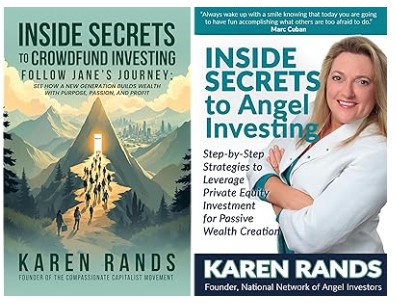
Get the Book that launched a movement: Inside Secrets to Angel Investing: Step-by-Step Strategies to Leverage Private Equity Investment for Passive Wealth Creation
Grab the book that is disrupting the status quo and inspiring a new generation that they have it in their power to leap the wealth gap: Inside Secrets to Crowdfund Investing. Follow Jane’s Journey: See How a New Generation Builds Wealth with Purpose, Passion and Profit.
Get the books - https://amzn.to/47D5Lwz
Sign up for The Compassionalist Academy, COMING SOON, and if you hurry you just might get in on the countdown to launch and claim 25% on an annual license. http://compassionalistacademy.com
0:06 The Compassionate Capitalist Show empowers entrepreneurs and investors alike to create wealth with passion and purpose. Join Karen Rands, a best selling author, for insights on Angel investing, crowdfunding, business growth, and wealth creation. As a seasoned entrepreneur and investor herself, Karen engages in dynamic conversations with industry leaders, successful entrepreneurs, seasoned Angel investors, and venture capitalists as they share their proven strategies and lessons learned. Once you listen, you will understand why this podcast is ranked in the top 2 1/2% globally. Subscribe and share and be a catalyst for the compassionate capitalist movement. There's no giving up and a go in back and you must keep an open mind and you try your best just to leave your track and do not fall too far behind.
1:00 Regret is for the faint of heart. In the end, it's all the same. Take what the wise I've got to. In part. These are the principles of the game. The principles of the game. These are the principles of the game. OK, hello Karen Rands here. I decided to do a segment on this compassionate capitalist show specific to the reasons why and the benefits why and the myths about Angel investing and why those myths exist. If you have been listening to this podcast regularly, you're likely one of the apparently minority of people out there that know and embrace the idea of investing in entrepreneurs as an asset class.
1:56 It is kind of the whole premise behind what I do within the Compassionate Capitalist movement and the Compassionate Capitalist Show and you know my book and everything like that. But if you're new to this, because I am gaining a lot of new listeners these days or you're one of those business owners out there, those executives that just like these business type topics and never really thought of yourself as being somebody that could be an Angel investor. That's never really been something that you were like, you know, oh, that's something that other people do. Well, this is the show for you. OK. And, and I really hope that you get great value of it. Listen to it all the way through. Give me a comment share it because we are getting this movement for compassionate capitalist go wing.
2:39 All right, so let's start with this. So I you know ChatGPT all the rage right? Yeah, The reality is that it doesn't invent anything. It isn't smart. It's just the best crawler for a search engine. It basically knows it goes out there to the world of Internet stuff and pulls the information right. So it's always nice to see if like what I think does ChatGPT agree? So I asked it what is an Angel investor and this is the what he came back with. Angel investing refers to the practice of investing money and startup companies or early stage businesses typically in exchange for ownership, equity or convertible debt. Angel investors are typically individuals who have accumulated well through successful careers are looking for high risk, high, high reward, high return investment opportunities. Well, you know, the irony of that is that they obviously have not got on to the the bandwagon of crowdfunding investing and how the entire marketplace has changed. And that could be because very much like what you know, the reason why most people still don't know about Angel investing is that it was illegal for 90 years. I want to talk about that more in just a second, but so JOBS Act passed in 2012.
4:00 That was when they removed 90 years of laws making it illegal for non millionaires to invest in start up at early stage companies. It was even illegal for the companies to solicit investment from non millionaires since 2012. The opportunity for anyone with disposable income to invest in private businesses has been available. So about 10 years now. It took a few years for it all to roll out, but the whole idea of it, it's like, and I'll talk more about that in a in a bit, but I want to let that settle in.
4:42 On one hand, you have 90 years of secrecy behind closed doors, right? Heck, when I was managing, you know, the Angel group where I learned all the stuff that I know and I talk about now and I wrote the book on, I'm going to show that you see it right behind me, right? For those that are watching on YouTube, on my YouTube podcast channel, I, when I was running that Angel investor group and we would hold our dinners and pitch events, we had a requirement of the venue to be able to close the doors. I remember this one place here in Atlanta, Buckhead Club, when we were expanding and we needed a bigger space. Their bigger space was in this loft and it had no doors and we couldn't have our meeting there. We could eat and mix and mingle there, but we had to go into another room and close the door.
5:35 So just on an off chance that somebody walking by would hear the companies presenting to this group of angels and asking for money because that was illegal. We did not want that company founder to go to jail for violating security laws. I mean, it, it, it really was that way, right? And so it's just amazing to me, right? But because what were they doing? If you, if you've been to my website and you watched me, heard me tell the story of the secret society, that's really what it was. We were a part of a, a secret society, a community that would meet to determine which entrepreneurs were worthy of getting money so that that that founder could go on and succeed and build a company that we believe would be successful and we would make money in that process, right. That's really kind of the, the, the premise behind all that to get a return on that investment.
6:42 And so if you've listened to any of my shows in the last five weeks, you will know that I have also launched the compassionate capitalist wealth maximizing system. It's a live hands on training digital course, totally interactive that maps to the book I wrote to serve as a primer to provide the pathway right the inside secrets to Angel investing, the lighted pathway for millions of American, maybe even those in faraway lands can learn how to be an Angel investor. Of course, that book, Inside Secrets into Angel Investing was the first step in putting the information out there. Then the rebirth of this podcast and then now the launch of a course.
7:25 And with that, they'll be there there. There are DIY. You could do it at your own pace. Log in at midnight on Saturday, on Friday night when you can't sleep or Monday morning, whatever. And, you know, be able to do your own look at your own thing. And also the intro courses are done on a monthly basis. And currently that could change based on market demand. I consider myself sort of in a, a beta test mode where we're putting a lot of this out there, seeing what works best for the, the market of, of really the, the, the people that are most hungry for this right now are the folks between 25 and 45 that are in a growth stage in their careers and are wanting to see about how to accumulate wealth, particularly the 25 to 35 year olds.
8:13 They are not afraid of crowdfunding, not afraid of reward based crowdfunding. So they're, they're hungry for this information. So I'm putting it all together to get out there and then I have a, a whole sort of it that's for those people that maybe did one or two. They've done a couple of Angel investments in the past and just really never felt comfortable that they really had mastered it. Well, maybe they made an investment in, lost their money and they'd like to do more, but they want to do it wisely. And there's quite frankly no training out there for it. Now there's hit and miss this, that and the other thing that people do and there's things that happen within a structured Angel groups, but there's really no structured training for this like there is for real estate investing, for example, or stock market investing.
8:57 So I'm solving that problem if you want to invest in me. No, I'm joking. All right, so so do you if you want to invest in small businesses and startups. I know it sounds intimidating. I get it. Now that I'm out there really pushing this whole education system, I get it. I get the comments from people all the time, but it's actually a smart and profitable way to build wealth. Investing in entrepreneurs is an asset class that's just as valid and profitable as the real estate or the stock market. Scout's honor. In fact, owning a piece of multiple small businesses can be 3 times more profitable than investing in other assets. 3 times more profitable. Google it.
9:48 Go ask ChatGPT and they'll tell you the same thing I found. And I found that even successful business owners, those that listen to my show, create thriving, profitable business but never think about investing in other entrepreneurs. I, I, I discovered this when I would be networking at the chamber and stuff. And these people that own $1,000,000 businesses and they've been invest in real estate, in the stocks and never think about investing in entrepreneurs as something for them themselves to do. It's always something that this mythical super wealthy got money to burn type of person becomes an Angel investor, and that's just not the case. The people that are Angel investors are active Angel investors are thoughtful about the process. They're very conservative with their money and they do it, which I'll talk about in a few minutes for a whole other reasons.
10:40 Yes, make money. But the compassion side of the capitalist side, compassion side, capitalist is making money. The compassion side is choosing to make money in a way that has greater impact and feels a passion that you yourself have. And that's what I teach. All right. You know, I was naive to think that my book was enough when I first came out with this book after the JOBS Act got passed. And I said my biggest fear had been that people would that would run out there and start crowdfunding investing and they'd lose their money. And then it it this, you know, investing in entrepreneurs would have, would have even a blacker eye right than than what has been created by the myths. Because if you think about it, for those 90 some odd years from 1933 to when the Securities and Exchange Acts were passed to 2012 when the JOBS Act was passed, people needed to make money.
11:49 Money makes money. And so all the wealth managers are financial planners that couldn't talk about Angel investing. What they talk about, they talked about stock market and people created education systems for the stock market. And then when the laws change or the rules or whatever, the things changed in the 80s for real estate. Prior to the 1980's, the only people that had invested in real estate were super, super wealthy people and institutions. But then they changed on, you couldn't get a loan for investment properties for a long time. And they changed tax laws to allow people that invest in real estate to write off business expenses. And when those changed, then you created the whole cottage industry of, of how to invest in real estate started to happen. So that that's where I am.
12:33 That's what I'm doing right now. I am where that real estate education investment market was 30 years ago. We're starting that right now. And you're listening to this because I'm going to tell you, I'm going to give you the details, the information that you need to make a decision on whether this is something you want to invest time in learning before you even make your first dollar investment. Right 'cause I, I wrote this book, it's got a step by step guide. Every end of each chapter says you know what to do next. And it has a resource portal with the tools that, you know, any investor would need to make decisions about investing in entrepreneurs.
13:18 But I didn't ever do anything more than that. I didn't know how to, I didn't know I finally found the right person to help me put this together and and put this out to the benefit of the marketplace. Because you think about it, 150 million people invest in the stock market, 7 million people in the United State invest in the real estate. In both cases, that's people that are making just $75,000 a year or more. That's not a millionaire, that's a middle class person, OK, That is putting money into these other asset class thinking they are the best way to create wealth and the least risky because they don't know about Angel investing and what they hear about Angel investing, word on the street, word of mouth is that it is risky.
14:15 It is like gambling. It doesn't have tangible assets associated with it. Oh, you can't get your money back. Oh, all this stuff. And I and if we have time, I'll I'll go into those kind of things as well. But I talked about that in the intro class very much so right. So in that is the sweet spot of the opportunity that the government was trying to provide to investors like you and me. I'm not a millionaire, but I'm a millionaire adjacent, right? You know, they wanted to give us the opportunity to invest like millionaires the way the mega rich millionaires have been investing for 100 years.
14:55 That was the secret again, from 1930, three, 2012. And the reason why was because those Titans of industry, the Rockefellers, the Du Pont's, the Hiltons, the Shell, all of the different things that you hear that you know about the people that were creating and building America back in the industrial revolution, right? Back in those days when they passed the security laws that said you have to disclose, right? You have to be the the public market stuff because of the Great Depression, the stock market crash, those folks knocked on the SEC doors and said, hey, we want you to carve out exceptions for private transactions because we want to be able to continue to invest in each other's businesses without having to tell the government about it. And they said, all right, we'll do that for you. And so that's what they established the rules that said no general solicitation.
15:54 That's why we had to close the doors, because if the doors were open and the public could hear, then that was a public solicitation. When they pitch at these big venture conferences, they should not be saying, and now they can in some ways, but they shouldn't have been saying. I used to have the rule at my big pitch events where there were, I didn't know. Everybody in the audience was not necessarily an investor. They could not say from the stage they were raising capital and how much they were raising. It was clear and obvious that people were raising capital. That's why they were there. But then they would go and have private meetings to have those conversations. So we stayed within the laws of the SEC on how to solicit.
16:34 You had to have a relationship with the person. The Angel GroupMe became the anybody that with the screening process, that was the relationship. But that was really the rules of the day. And so in the vacuum, what did people do? Invest in gold, invest in stocks, invest in real estate, invest in bonds? Right now, just on an aside, in the crowdfunding space, there's a company up in Baltimore that is just fascinating. They issue bonds on behalf of a company to the community. The community buys the bonds. They have a guaranteed return, you know, back on them. It's, you know, low. It's like like a way a bond would be in investing in local businesses in that community that are having an impact in that community and they're doing it through bonds. I thought that was brilliant, right? There's so many ways that you can invest in entrepreneurs. You can be a bank, you can loan them a little bit of money, bridge them, you know, help when they're getting ready to do a big order, the retail order to Walmart or something and they got a go to manufacturing.
17:44 They're you they want to bring manufacturing into their, a $10 million company, a guy, you know that or gal, you know, from the chamber and they want to bring manufacturing into the United States from offshore. They can go get an SBA loan for this amount, but they need this other amount to higher up people, you know, do their marketing for this new product they're launching. You could be an investor in that and it could be structured. I'm gonna, I'm working with a company right now on this in a what they call revenue financing. So you get paid back a percentage of those Rev that revenue on a monthly, quarterly or however it gets structured basis until three times your money is paid back. And you know that that company has the contracts, you know that that company has the ability to make money. So where's the risk in that?
18:31 Yeah, there's some risk, but not as much as there is in the stock market that you have no control over and often times in the real estate market. And we're going to talk more about that here as I proceed on right. But I, I, I get excited about this. I actually have a whole thing. It's taken me days to write the show notes for what I want to Tell with you today, back and forth, editing it and stuff like that, and I've already digressed 3 times off of it. But anyway, so they wanted to give millions of Americans the opportunity to invest in the potential of entrepreneurs and their growing business, and I'm going to tell you exactly why in just a few minutes.
19:12 The crazy thing to me is what little actual understanding and even basic awareness of the possibility there is out there about the value and benefit of Angel investing, even if you're only able to invest in crowdfunding companies. I mean literally. And I'm going to give you 2 stories, OK? I'm going to tell you 2 brief stories about conversations I've had within the last couple of weeks that drives this point home. So the goal of the Compassionate Capitalist Wealth maximizing system is to shepherd new investors to the concept of investing in entrepreneurs and those that have some experience at Angel and crowdfunding investor to get better, to be more confident through this. These steps become comfortable and confident with investing in entrepreneurs as comfortable as they are in investing in the stock market in real estate, right? It should not be elusive A myth or anything. And by the way, if you want to sign up for an upcoming intro class or just get in the queue to Start learning more about. The actual interactive training at the Compassion Capital with maximizing system, they go to dothedeal.org. dothedeal.org. It's also in the show notes.
20:31 But do the deal dot. All right, I said it three times and I will say it again before the end of this. So let me tell you this first story and I'll tell you the reasons why Angel investing is still a secret and what the myths that discourage it are and why they exist and the reality of the benefits of learning how to invest wisely in entrepreneurs. And you may relate to these stories. So first is a friend. She's retired with a good pension, considering investing in real estate, open to the opportunity. I described she'd been watching some of the stuff I've been putting out on Facebook and she asked me if my friend Jane, she asked me when she ran into me at this meeting, She said, why is it that I'm always talking about investing in entrepreneurs?
21:12 And she wondered how is it better than investing in the stock market in real estate? My favorite question. I explained to her that investing in entrepreneurs is my passion because I love the idea that somebody sees a problem, figures out a solution to that problem just from the imagination they have and whatever knowledge they have or ability to go and find people that have knowledge and they create a solution that solves a problem that changes our world, makes it better that just the idea, that basic idea makes me excited. I'm just excited about that.
21:58 So hell, and I've seen so many ideas, so many done deals, things that are that would solve fundamental problems, save lives that never get to where they need to get to make an impact because they didn't get the funding, because there's not enough investors out there. I gave you those numbers, the 7,000,000 real estate investors. You know how many investors there are in entrepreneurs right now? We're talking 90 years. So 90 years that it's been a secret even with all the the rise of the dot coms from the the 80s into the 90s, you know, OK into the 2000s when the that crashed. So even all of that car carian in an Angel group, about 350,000 Angel investors in the United States, there's about 7,000,005 to 7 million accredited investors, those people that technically could be the official Angel investor in the United States, but there's only about 350,000 that invest in in entrepreneurs through Angel groups. So there's some number that's not tracked that way. And then there's some people that invest in the Reggae Plus and these other kinds of offerings, but in crowdfunding in Reg CF OK, which is probably the biggest group of crowdfunding investors in Reg CF Red crowdfunding 350,000 in 2022, Is it too good to be
23:33 people that are making that $75,000 or or more, right, that aren't, you know, making $400,000? So somewhere in that gap between 75,000 and 300,000, you know, perfect place for crowdfunding investors 350,000 and it's been 10 years or are you OK? So Reg CF was 2015. All right, Even that seven or eight years and there's still only 350,000 in that. And you know, that's just, it's like amazing to me. And I'm going to talk about something because you're going to, I know you got a question coming in there and I'm going to guess your question here, but you know, and, and so I told her that it's my pot, my passion because of this, right? And that I do the take the time to produce this podcast every week to really help entrepreneurs and investors learn about the best practices for creating wealth by building successful entrepreneur endeavors and being an investor in those ideals without all the risks. Because, you know, launching and growing and successful business takes a lot of time and money is risky when you are the 1 putting in all the time and money.
24:39 And I shared with her some important reasons why investing in entrepreneurs is a great idea and what it means for anyone who's interested in building wealth. The first reason, and I said this before, it's three times more profitable than traditional investments like real estate and stock market. Three times more profitable. Hey, why not? And then the second reason is that you're investing in entrepreneurs is no more risky than other forms of investing as long as you know how to build a diversified portfolio. And I share the statistics, right. So if you Google it right and a chat an average turn on investment of real estate and the stocks, they typically they look at a 10 year rolling span and it goes up and down a little bit.
25:24 But on average they are between 11 and 13%, right. It correlate around 11 to 13% of return on investment. And that part of that is because stocks don't jump, they fall, fall hard and fast, but they only go up incrementally. And real estate has a whole lot of other expenses associated with it. So that your actual return on investment is a very small part of the total number of what that that asset might represent. But the average Angel investment portfolio, 30% / 30%, actually, I think it's like 36%.
26:07 It's a fact, right? And I know, I know you're saying hold up here and hold up here. And if it's really three times more profitable, how come I don't hear about it all the time like I do, you know, well, want to learn how to invest in Bitcoin? I swear I think I get a message at least every other every couple of days from somebody asking if I want to learn how to invest in Bitcoin, right? Or why aren't my friends talking about getting into crowdfunding investing like, hey, do you want a crowdfund? My daughter even said on an Instagram thing or whatever or live stream she was doing 1 New Year's Eve, she says, Hey, anybody know how to invest in Bitcoin?
26:49 Hit me up right. Like, you know, I, I great question. I Scott had me scratching my head too, because when the JOBS Act passing and making it legal for anyone with cash on hand to invest in entrepreneurs, I was literally afraid that millions of people rushed to start investing in the entrepreneur. I mean, I literally was, I was panicked that this thing that I felt so much about, because I felt like the biggest barrier to entrepreneurs raising capital was this general solicitations restriction. And we had to work around it all the time. Because my Angel investor group, I had 30 or 40 people in a room at a time here, but I had 100 plus investors out in the US that had signed up virtually to be a part of the Angel investor group and had given me all kinds of information about the things they invested in. And so the way we had to engage them, that was actually really the reason why I started the podcast to begin with, way back then was to be able to do an interview with a entrepreneur that was raising capital without saying they were raising capital, but saying, Hey, they were just at our Angel investor event.
27:52 And, and you know, we would talk about their business proposition and their, and what they were, you know, all the opportunity, the problem they were solving all the stuff without talking about the raising capital. And then we would create a trackable link, send it out to the entire network of my investors and those that clicked on it, then we would follow up and say, Hey, looks like you were interested on this, right? And so that was, that was literally the main reason why we did it and SEO backlinks, right? That was the main reason why we had we had done it to stay within the rules of this general solicitation, right. And so I was just really worried that this I called it a redheaded stepchild. And no, no offense to redheads of an asset class, but you know, they that because the biggest mistake that all that investors make when they're first getting started.
28:40 And I myself had made this same mistake investing on emotion invest because you love that particular entrepreneur investing on emotion without going through the paces of deciding whether this company was really worthy of your investment. And I was, I was on a board call a day with a company that I'm working with. I talked to the board of directors about, you know, where they are. So the difference between like a friends and family and the easier money that it takes for an entrepreneur to raise versus, you know, going to business angels is that they're typically people that believe in the entrepreneur or believe in what the entrepreneur is trying to do. And they're like, oh, I can't believe somebody hasn't done this before. Got to get, I want to see this this solution in the marketplace. So they'll throw money in based on emotion. Business angels don't do that because they've, you know, they've, they're, and in that case, when a company is raising beyond their seed round, they're competing against all the other companies that are raising capital. And did I not say there's a finite amount of capital, 350,000 registered card holder and Angel investors 350,000 that are invested in Reg CF right.
29:46 But there's literally probably a million companies raising capital, you know? And so so anyway, I thought they needed this book. And I did not want to give any more fodder to the financial advisors out there that have been spreading the fear, uncertainty of doubt about Angel investing to be able to tell their clients that went off and did this, that, you know, they've been saying it's too risky, you can't do it. I told you so. And, and by the way, the reason why they, they discourage Angel investing wasn't because they thought it was too risky. It's because of the rules of the SEC set up that required the only way for them. They have this thing called selling away. And so if they advised a company, a, a client on investing in an, in a private equity transaction because it's securities, then they couldn't and it wasn't being run through their broker dealer.
30:47 They, even if they didn't make money on it, they, they would fear that they would lose their license because they'd be selling away, whereas real estate is not a security. So they could say, yeah, take 10% of your portfolio and invest in real estate. You should invest in these kind of things, that kind of stuff, you know, rather than you know, And they might even take a look at it and give them their two cents worth. But it wasn't considered selling away when but there was. But early stage companies that are raising $1,000,000 is not something that a Merrill Lynch is going to take on. They only take on deals that are raising $100 million because they have to make it available to all of their investors, you know, when they do a private equity transaction. And so that is just the nature was the nature of the beast and they brokered dealers have to charge big fees. They charge 10 grand retainer a month plus 12% of the transaction.
31:43 No company raising $1,000,000 could afford that. So there was just this disconnect, which again, ergo why the JOBS Act was necessary. And I think, and I think it could be because you know, everybody talks about Bitcoin. I mentioned that, right? And people go like, why I hear about Bitcoin? Why not? Why don't I? Why don't I hear about Bitcoin investing and I don't hear about Angel investing? Well, it's because it's in the news all the time, good and bad, but it's in the news, right? And you can track its value and it's wild ride. It swings just like you can the stock market. When I was preparing for this, I went and looked, what is the latest price of Bitcoin today?
32:23 And I could look at what was the price for the last year. I could totally see all the ups and downs. You can't do that on Angel investing because they're private, right? So it's something that people can do. They can Google it, they can see it, they can do all that kind of stuff, right? And you can get involved for just, you know, like if y'all watched Super Bowl, not this last year, but the, the, the year before when Coinbase did the ad with the QR code bouncing on the screen. This is a Super Bowl ad, right? And I'm up there and I got it, the QR code and they gave me $500 credit, I think to be able to go and invest in, in Bitcoin infractions. You could, you could do it for 500. I, I get like a tiny piece of one Bitcoin or I could go find ones that are in the start up stage of a, of a cryptocurrency that I might be able to buy for $500, you know, And then there's these news reports of the teenager that made 10s of thousands of dollars in just a few weeks, right? I, I, when I was looking at this, I saw he's got a whole thing of a whole series of videos now talking about how he did it right.
33:34 And when you have huge celebrities promoting crypto like Larry David or Tom Brady or even Matt Damon during NFL games, when you have a huge audience of people that really, quite frankly, like to gamble because they're doing fantasy football, they're, they're able to do all these things to them, then it is, is ripe audience because their level of like, oh, why not this too? And Matt says it's good, but just like the guy in that funny TV ad, I, I couldn't find out who it was. I think it's some kind of job, like a jobs ad for like Indeed or something like that. And you know, one day he's celebrating, oh, he's a crypto millionaire and he's going to like resign his job and he's out at the clubs at night with the big champagne and like that.
34:21 And then the next day he's back at work broke because of the fluctuation of the market. When Matt Damon did the crypto.com ad in 2021, Bitcoin was trading at 60,000 about $60,000 apiece. A year later a Bitcoin. So in 20/22 it was 20,000 dollars. 3770 a year did year to date on that. Today is 26,485. That's I just checked it today. In fact, in the past year it has not gone above 30,000. I call that risky. And the thing that I think about Bitcoin that people don't really get, I mean, sophisticated investors, you know, people that, that have worked on their financial intelligence, you know, like if you ever looked at any Robert Kiyosaki's kind of stuff, Sharon Lecter, you should watch my podcast with Sharon Lecter. But the cash flow quadrant, EBSI, entrepreneur, service providers, the sole proprietors, business owners and investors, right?
35:30 So this side of the equation are people that have to deal with money after taxes, taxes are taken out, right? And they're, and they're all about time and money. Time is exchanged for money, whereas over here business owners are building businesses that operate without them being there because they have systems and stuff like that. So it's like they're making money in in their sleep. I was listening to this. I was talking to a, a friend of mine today, a lawyer that I was going to engage. And he has a side business he started that is water bottling. And he has an alkaline water product that he brought out. And he said, you know, last night I sold 10,000 cases in my sleep because it's out in Walmart and stuff like that, right? That's why business owners, you know, make the most money. What business owners are considered the best way to create wealth?
36:16 But what they don't think about is the I. The I is the investor putting your money to work, investing in things that make money in your sleep. So when you invest in a business owner that's working their tail off to create wealth for themselves and their family and their generation, you make money too in your sleep, All right? That's, that's that piece of it, right? And so when you look at when you look at crypto, what is it? It's like day trading. It's very volatile because although it is in a transaction like public stocks, right, you buy and sell stocks in the public market from another stock owner. In crypto, you're buying and selling from one crypto owner to a you're the next crypto owner and and there's a transaction that goes up until there's a sell off. Same thing with the stock market and there's a sell off. The stock markets drop.
37:14 And sometimes it it can happen because of very specific reasons like catastrophes like 911, all your travel and transportation stocks dropped, all your planes things dropped. Everybody got out of that sector, but it's usually the big money markets that are moving. Hedge funds are moving money out of a sector and stuff like that. And I have a theory that part of the reason why you see a volatility in the stock market, if you would just track it with the sorry for those that are watching. I keep messing with my hair because my fans blowing my hair on my face. The stock market a, you know, if you, you correlate between a drop in Bitcoin or dropped in the ICO markets and the Ethereum and those kind of stuff. And you would see correlation of the big market makers, the big, big, big market movers moving money out of their stock holdings to offset their losses in crypto to keep their investors whole and the overall performance of their fund strong, right?
38:11 Just sort of my theory. You know, the thing about it to consider with crypto is that there's no financial performance of a company to consider or the assets own or anything that might give the market makers reasons to want to buy the stock and drive the price back up, right? When it comes to to crypto, what drives it back up its demand. But you know, if there's it's, it's like the ultimate Ponzi scheme and, and World Economic pressures aside right there. I believe that there's an inner relationship. There's lots of just things that have like caused the stock market to drop in different areas and different sectors.
38:53 But it's just, you know, I know friends of mine that that they did get in early, so they have made money. And even with that drop of 60 that they didn't buy at 60, they bought at 10. So even at 20, they're still making money. But they get up at 2:00 or 3:00 in the morning to make a transaction because it's not even a fixed price of the transaction. The actual cost of transaction varies on demand. So everything about it is variable. That's about the pure definition of risk I could possibly imagine compared to Angel investing. And don't get me wrong, my disrespect for crypto does not apply to blockchain or even NFTS, non fungible tokens. Because crypto is an application on blockchain. Just like smart contracts, the stuff that do it in real estate, supply chain management.
39:44 Lots and lots of great things happening on blockchain that fundamentally is shifting and advancing business in ways that we couldn't even imagine before. And NFTS, they at least have something of value attached to it. And and even if it is art and it's subjective and you may not feel like why would I do a why would I want to get a cartoon of a monkey? There's a whole other area that it is, it is tracking where I've seen opportunities where it's they're using NFTS, non fungible tokens to track assets of like when people. By a limited release of something and they want to prove that asset of value that it can't be plagiarized or copied, they put an NFT on it and so it could be very well-being a tangible something of value that has an NFT, not even a digital market of something.
40:42 I have a vision that as I build this virtual network of Angel investors through this program, I will be offering and it as part of a membership in that in the future. I've got it all mapped out on how I'm going to do that. So yeah, I'm, I like NFTS and I love blockchain, all right, It's very different than crypto. So back to my story about Jane. So I told her about how you make investments in increments of hundreds or thousands of dollars even or, and own a small piece of multiple businesses, right? Like this, right? And then those businesses are run by passionate entrepreneurs who are bringing an innovation to market that use your money to grow their business. And eventually they build it to sell the company to a large company or go public or sell their stock and sell their stock on the open market.
41:34 And then you get your return on investment. But as I mentioned before, there's all kinds of different ways. The thing that I had called the Angel Profitability Blueprint is designed to help you build a portfolio of 10 companies. So that will produce different types of, of returns on investment. So have you heard that you can create great wealth as an entrepreneur? And then by default, you must know that you can create great wealth as an investor in those successful on the, on the on in entrepreneurs. It it's just a fact. It's just logic because the companies that you know of that you buy their products for all that kind of stuff, then currently that's what they do.
42:17 They, you know, there were Angel investors in those companies. One of the topic objection objections about Angel investing is that it's too risky because the odds of the business feeling, oh, you know what? Data from the Bureau of Labor Statistics show that 20% new businesses failed during the first two years of being open, 45% during the first five years and 65% during the first ten years, and only 25% of new businesses make it to 15 years or more. You know what, In the 20 years that I have been working with entrepreneurs over 20 years or even to my IBM days ready getting them ready to attract capital and coach them on how to raise their seed round, those stats have not changed.
43:00 They have pretty much been the same statistics, yet millionaires still invest in them. They can invest in anything they want, but they still invest in entrepreneurs. And being an investor in a business is not as risky as being the founder of that business. Yes, you may lose the money, but you don't lose everything else, right? And that's the reason that's and I would venture to say part of the reason why those companies fail after that five years, stuff like that is because of lack of access to capital. The very problem that the JOBS Act was was trying to solve access to capital, unlocking the check accounts, the 4K's and the self-directed Iras of those 7 million potential accredited investors and the 7 million people that invest in real estate and the 150 million people that invest in the stock market. Because they could all be investing in entrepreneurs if they knew they could and if they knew how. All right, Yep, that's right.
44:06 So it's the Angel profitability blueprint is my, my element of success on this. And I'm actually going to offer it up as a, a, a free download, something that's available just for free for those people that sign up for the intro classes, because I think it's important. It's an important take away. So it's designed to give you a short term returns that you get money back in the few months, you know, within a year, as well as income producing returns, just like rental investment property and long term big wins like your traditional IPO or, or if you were investing in real estate for a long haul, or you thought you were investing in a Blue Chicks chip stock.
44:49 And we're just going to keep it in your portfolio. My dad gave my daughter when she was born a very little about 10 thousand $20,000 worth of stocks in blue chip companies, UPS, Coca-Cola and maybe it was just those two and and Delta, well Delta got hammered in with 911 and UPS something else, Coca-Cola something else. Anyway, those, the stocks went up and down, but they did not retain their value that of what he gave them. They were never back. They, they did not get back to that value. You know, maybe now 25 years later, they are and they're more than that because they go and do stuff.
45:33 But it just, you know, it's really quite amazing that, you know, you think that, but that's it. It the stock market is just as you don't lose your money if you don't sell. So you just hold on to it. But it it takes a while And I'll, I'll talk some more about that, too. So my friend said she had been planning on investing in real estate, but the market has just risen. The prices have been rising. The mortgage rates are higher than she expected for the investment property. Yeah, they're about two points higher than what they are for real estate. I mean, for, for private, your own personal home. And, you know, there are other benefits to investing in entrepreneurs. It just seems so risky because there isn't anything tangible like a house associated with it. And that's where you, you, once you understand the structure, once you understand things, you understand that you can make those decisions and you can see the value.
46:21 It is in what the company is doing, the product that they're building, their intellectual property that's protecting the that property, that product from competition. Those are the assets, right? It is what they're building. The company itself becomes the asset. And yes, I said it, I get it. This is the same boat a lot of people are in. And here's the thing, one of the reasons why the JOB Act was passed bipartisan in Congress 2012 was because if you recall, the financial collapse of the mortgage-backed securities real estate bubble had crashed in 2000 and nine 2010 time frame. I doubt much of the real estate holdings of the investors plus the received equity value of their primary residence. You see, what makes real estate investment risky and expensive is that investors, most of those 7 million with the income of $75,000 or more, are not buying real estate. They're taking out a loan with a bank and they are a, A sure they are a, they're a person that could own that, but they own it with the bank until the bank's loan is paid off. And, and anybody that owns real estate knows that. So you got to make enough money on your your rental to cover that mortgage plus the repairs when the the floor is flooded because a pipe busted during the crazy frozen time we had in December or the septic tank is full. And now you got to pay 3 1/2,
47:51 three, $3500 to have somebody come in and pump that out. Those things come out of pocket. And if you're only making $500 profit on that particular because of your mortgage on in that particular property, well, guess what? You just ate up how many months of income paying for whatever that is. So you know, you're it, it, it's just the nature of it. Or if you don't have the insurance that covers it or it's not something that's covered by insurance, you have to come out of pocket. And so that is what when your tenant moves out and you got to fix it up, put new pet carpets in there and paint it so you can put it, you can charge more and get another tenant in there.
48:31 You got 3-4 months where you're making no income and just spending money. So those are things that don't factor in when they talk about how real estate. But that is that's factored in when the world of of return on investment says on average, real estate portfolios produce a 10 or 11% return on investment because it's not just an asset that's $350,000 that you own outright. You own it with the bank and you had to put 50 grand down in order to buy it right or to fix it up. So if you are sitting on So what that means to you If you have 10s of thousands of dollars saved up because you were going to buy another piece of rental property or get started investing in real estate. The rising cost of real estate is shut you out of owning that rental property.
49:18 Investing in entrepreneurs might be a great option for you. That 30,000 you saved up for your first or second real estate property, you could invest in 10/15/20 crowdfunding and companies with that truly make a diverse portfolio and do other things like what I've been talking about. I even told Jane about how to unlock the capital in her four O 1K so that she could direct her four O 1 K through a self-directed IRA or Roth IRA to invest in entrepreneurs instead of those low yield mutual funds or the volatile stock market that you might have when you, you know, say, oh, I'm going to put 50% in the stock market and 50% in this, you know, mutual fund, right? Speaking of the stock market, my other friend, the the other one I'm telling you about now, my friend Bob, he's a well paid employee with a substantial stock market portfolio, very proud of his stock market.
50:13 In fact, it drives a whole lot of his decisions on everything else in his life is what will make my stock portfolio go up. It's how he votes, right? I actually, and he actually had purchased my book when I first came out and read it and even shared it with many of his friends. Yeah. When we were together recently, he said he asked me why invest in private company versus public companies. I had to, like, keep my poker face on because I was just stunned that he was out. He read my book, and here he was asking that question. And I share with him the fundamental difference. When you buy a public stock, again, you buy it from another stock investor, not the company. It is a transaction between two people or the institution that's selling it, like a hedge fund that's selling that stock. The only benefit to the company when their stock goes up is that they can leverage that for acquisition or debt financing, right?
51:16 They can leverage that and it's, it's, it's, you know, shareholder value is a, is a big deal when it comes to their financial strength of their, of their portfolio of what they have, right? And so, but the biggest challenge start-ups, small business owners have getting the capital they need to start and grow their business before cash flow and profits sufficient to fool the growth on their own. Angel investors, crowdfunding investors, community investor. That's kind of a new thing that's happening. Investing in the companies in your community invest, invest in that sweet spot spot between an ID and bankable or if this in in the programs that are expanding business.
51:56 I kind of talked about that like you're investing your, your, your fellow friends business, right? Like through the Interstate exemption or Reg A+. It is the capital a company needs that exceeds what they can get from a bank. That money comes for those private investment funds and the jobs will be created, The products will be invented to solve a problem in the marketplace and expands the the economy because of the ripple effect it has for those investors that grow into what I call business angels. People in the business of investing in entrepreneurs as a regular part of their life. It's like a hobby that they, they work on getting better and better at with each investment decision, right?
52:40 It's something that they become interested in. They want to learn about it. They want to do it. So like if you wanted to learn how to become a skier, you don't just jump out and start skiing. You take a training course, you practice and then you go down the, the big, big black diamonds, right? You don't just do that to start with. Just because you can doesn't mean you should without the proper training. That's why I'm, I'm doing what I'm doing right now, right? So they do it because they also do it. Angel investors also do it because of these feelings of contribution, the impact their that their money has when their money goes into a company that's solving a problem that they're, they care about, that they're passionate about. It could be something that's that's in their own life.
53:22 It could be a problem that they wish they had a solution for. It could be, you know, I see it all the time, you know, and if I, when I was running my Angel group, we would have companies that the people would say, oh, I'm a soft software investor. But then somebody would come in and they would have, there's this company that they would have a solution where it was a pill dispenser that could be connected through Internet or things for home health. And you would know whether your mom was taking her medications even though you weren't there. And the nurse could check in on her, you know, through a telecall, you know, to be able to check on her. And because their mom was, you know, in that situation, they would be like, I want to invest in that, right? So that was the emotion. They were passionate about a problem that was being solved that they hadn't really thought about. And and that's that compassionate capitalist part of it, right?
54:12 And so and they get this, this sense of satisfaction watching these companies grow, watching their money being put to work for a company to get to a whole nother stage of business. It actually Angel investing, investing actually satisfies the six fundamental human hierarchy of needs. And I did a whole series of videos on what that is and why those is. And they're, they're part of the now part of the maximizing system. And you could still go to YouTube and find them. If you go find this on YouTube, you go to the compassionate capitalist channel, they're listed there's, but you don't get those feelings in the stock market. You're just buying and selling. It's a transaction. I mean, you, you get feelings of, Oh, my money's going up and your money's increasing in value, but there's no other sense of, of reward and fulfillment in that.
54:57 And you don't get that when you're buying real estate for a rental company. Maybe in a flip because you saw, you know, this ugly house turned beautiful, right? And that's a sense of like, oh, it's done. But it's really more like it's done. It's like, it's a thank God it's done and now I can make money on it. It's not because you're watching something grow, right? And it's not that you're solving a problem that affects millions of people or changes the world because a whole new market has been created. Many people think of investing in entrepreneurs as too risky, but it again, it's no more risky than real estate or the stock market when you know how to build a diversified portfolio. I mentioned about the real estate crash and this at the same time the stock market crash and tumbled.
55:41 It took 10 years for those values of where they were just to get back to the spot they were when it crashed. 10 years, really 10 years when you looked at the, the, the market in general. Now, obviously there's exceptions and in certain markets here, but it and by and large it was, it took them ten years. And and so technically you don't lose your money if you don't sell. But this idea that Angel investing is illiquid because you might have to hold it for 10 years. Well, I just showed you there that you know you if you lose the value in your stock market, in your real estate, if you're able to continue to make the payments on that real estate, you will have to hold it 10 years to get it back. At least that's what it took.
56:24 OK, now we have a surge, another bubble that we're in the middle of because of of a whole nother reason why you talk about that. But the key difference in both those cases is that the factors for the real estate in the stock market collapse were outside of your control. The value is set by the buying and selling like crypto, it takes time and demand demand to regain that value. Where with startups and grow states, companies, the money that you along with hundreds of others, maybe thousands of other investors are going directly into growing the value of that company, bringing out products, new products that will grow the revenue, increase the value of the company. And that's not not because of a transaction, but because they're building something of value.
57:10 It's the company. Remember, investing in entrepreneurs has a long history of success among the wealthiest investors in the world, including the DuPont, Rockefellers. Nearly every company that is public now or household name had Angel investors. And at some point, Home Depot, Amazon, Microsoft, Facebook, Dell, the JOBS Act not only intended to Open Access to capital for entrepreneurs, but also for those investors that had lost that retirement and their real estate and the stock crash. They've lost their real estate. The industry lobby Congress to change the laws. And they did because they saw the rewards, the results of reward based crowdfunding. Think about it.
57:53 You didn't know that you don't know this I talk about in the book. If you haven't read my book, if you haven't heard me talk about this because you don't have a follower of me on stuff, but 3D printing, drone VR headsets, even fidget widgets, I'm holding one for those that are watching right. Even fidget widgets all came to market because of reward based crowdfunding. That was what was around for 20 years before we had equity based crowdfunding. Literally 20 years. OK, that's how a lot of films music got done. Reward based, right? I got early access to something, I get a reward, I get something in exchange for my money, right.
58:35 So they pre purchased these products even before in some cases they hadn't even been made. They were they they you didn't even know for certain. They I have a prototype. They knew it worked, but they hadn't made any kind of a lot of them, right? And so they would put hundreds or even thousands of dollars into these companies and these companies raised millions of dollars in reward based crowdfunding. And then they went on to raise VC money and sell their company or like Oculus headset, right? They got first got 100 million or something from VCs and and Facebook and then Facebook bought them for billions of dollars. You know, the reward, the people that had bought those original versions of those Oculus headsets made nothing on that.
59:19 They gave them the seed capital, you know, hoping to get a product, right? And those companies got launched, but they made no money on that. And it wouldn't, it wouldn't be like you, you would have made 50 grand on $1000 investment, but you might have made 5K, right? You at least would have had something different. You might have had the product and equity. That's the way a lot of them are doing it now. So Congress said, why not let the middle class get to invest like the ultra high net worth people and start to bridge this wealth gap. This is particularly keen for women and people of color that have not have long, long, long, long, long time not had a seat at the table.
1:00:02 Pull up a chair. I say pull up a chair. And get and Start learning about how to invest in this asset class. And when that company goes public, excuse me, even even in the.com bomb, right or so we need real, real tell investors jump into the market on jump on a stock. We saw this with Facebook, we saw it big time with Snapchat. And so say the the strike price is at $15 a share and it rises to $20, you know, and it's going up and up and up and then all of a sudden it starts to fall and it goes down to $10 or something in a matter of weeks. After the initial IPO. The people that invested when that company was starting up and growing, those people that put that money at risk but saw the future potential of what that company was going to do and the impact it was going to have and the revenue it was going to generate.
1:00:55 And then they put that money in and they might have started out at $0.50 a share or a dollar a share. OK, when, when that company IP owed at $15 and then they sold the stock at $20, they've made 20 times their investment. But those got people that got in at $15 a share and thought, oh, yeah, yeah, it's going to go. And then just a couple of weeks later it drops to 10. They've already lost $5 a share. All right, everybody like, so by the time you hear about it to buy it in the stock market, it's too late to make money on it. I mean, you could, you will make money on it, but still there's a way for Angel investors, some of these Angel investors, there's organizations that you can buy stock in a company like 23, 23andMe, Airbnb, all these companies that are getting ready to go public. You can go and buy stock in those companies. Now you have to be accredited to do it, but you can buy stock in those companies and you won't get them because you're buying them from employees that have that have the stock right now. So you're not going to get it at a dollar a share if their strike price is going to be $15 a share. You might get it for $8 a share or $10 a share, but you'll still be able to sell it when it first goes public and you got it and you still have a basis point that's a lot lower than you know what people that buy it after it goes public. And not every company is going to do that, right? But but it is why you have a strategy for diversifying based on state industry and type of
1:02:26 offering that I call the Angel profitability blueprint. Ioffer it in this wealth maximizer system. All right, so I want to encourage you. I I thank you for listening for as long as I've been talking. I was going to get into furthermore into risks. I guess you'll just have to sign up to learn more about how I overcome risk or, or please to go and follow me at go follow me on Facebook and on LinkedIn and stuff like that because I do put out videos on these topics. But go to dothedeal.org, dothedeal.org and you can sign up for a free intro class. You'll get in, you'll get a free book called the 12 secrets of innovation and wealth on that will be given to you as well as part of that. And you'll get, you'll start to get my video tips that I talk a lot about this stuff and I you know, you'll get, you'll learn, you'll do the first step that says this something that you want to invest more time in learning and do you want to invest money into, like getting into a more in depth training. You know, you'll learn how to make investments in increments of hundreds or thousands of dollars. You'll learn how to use the Angel profitability Blueprint to find deals, evaluate them, and build a profitable portfolio of at least 10 investments.
1:03:47 You get started on the path to learn the inside secrets to Angel investing. And you'll be able to invest in businesses where passionate entrepreneurs are bringing innovation in the market. And you share their passion and you have the feeling of impact and contribution. Just I, I see it when I've had with some of my Angel investors and some of the things they'd walk in the room and they'd have a pep in their stuff because I could, I, I decided for those 45 year olds that were becoming my Angel investors at the time, it was like, better than a midlife crisis, you know what I mean? They could go spend 100 grand on a fancy new car, sports car, or they could invest in entrepreneurs and they got a greater sense of joy. You didn't need to go have an affair to bring it, you know, spice back into your life.
1:04:36 Go invest in something you're passionate about, a problem you're solving somebody. So there's somebody out there trying to solve a problem that you think needs to be solved. I promise you there is. OK, So again, dothedeal.org in order, this is the right kind of a thing for you. Don't and join this growing community of compassionate capitalism. With that, I'll say onwards and upwards. Thank you so very much for tuning in and listening and please share this very much. If there's ever a podcast to share or video to share, this would be it. So Kieran signing off, onwards and upwards. Have a great day. Thank you for listening to this podcast, The Compassionate Capitalist Show, brought to you by Cougar and Capital Holdings with Karen Brands as host. You are encouraged to visit the website cougarand.com to learn more about how Karen and her team help investors and Angel groups make money by avoiding investing in deals that suck, and how the Cougar and Capital companies and partners help entrepreneurs breakthrough their barriers to capital and live their dream by building companies that can scale and create generational wealth for their founders and investors. If your business could benefit from exposure to our audience of business executives, entrepreneurs, and investors, we are seeking financial partners and sponsors for The Compassionate Capitalist Show to
1:06:07 help us take this podcast beyond our 150,000 listeners and amplify the message of the compassionate capitalist movement by making this a Top 50 business podcast. The Compassionate Capitalist Show is available on YouTube, Apple podcast, iTunes, TuneIn, Stitcher, Spotify, Pandora, and Google podcast. Contact us at karenrance.co to learn more. And as a listener, you can do your part of the Compassionate Capitalist movement by subscribing wherever you listen to podcasts and sharing this show with your friends and colleagues. Be sure to pick up your copy of Karen's bestseller that launched the Compassionate Capitalist Movement.
1:06:48 Inside secrets to Angel investing. A step by step strategies to leverage private equity investment for passive wealth creation. Thank you for listening.